People some ask me what struck us the most while doing the Skiptune project, and the answer has consistently been the strong impression that new patterns of two consecutive notes emerge once in while at an irregular rate. Wondering why, an hypothesis came to mind that, loosely stated, composers incorporate a new two-note pattern when they tire of the two-note patterns used till then. We discuss this idea a bit on the “Measuring Creativity” page. There, we show several graphs demonstrating that the number of “words” (two-note patterns) in use during any era has been increasing inexorably from the 1500s.
On that page, we break down the eras and provide the rate of innovation (as measured by the rate of new two-note patterns) for each one. The final graph, including all eras, is reproduced here:
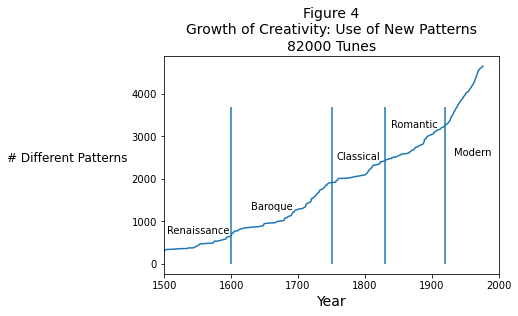
Once a two-note pattern is discovered, it can’t be undiscovered, so of course the line never takes a dip. But there are times when there are sharp jumps in the number of two-note patterns, and some eras have steeper slopes than others. No era is flat as composers keep reaching for new sounds. Steeper slopes are evidence of a higher rate of adding new two-note patterns to the “palette” available to composers in any given era.
This question of when composers feel the need to “invent” a new two-note pattern has an analogy in human languages where authors need to string words together in new ways. That research allows us to formalize our hypothesis. Doing so forces us to recognize that composers don’t “tire” of their vocabulary, but rather the following:
Hypothesis: That new two-note tuples emerge when the existing tuple vocabulary does not efficiently encode the expressive or structural needs of the musical context.
A corollary is that new two-note patterns emerge when the compositional system allows low-probability combinations to become perceptually meaningful. In other words, if a two-note pattern has not been used up to a certain date, it was because there was no need for it to encode the composers’ (collective) expressions.
Work by Maria Ryskina, et al, suggests that new words emerge in “sparse regions” of semantic space, and are more likely when nearby concerts are increasing in frequency. The analogy to the Skiptune project is that “semantic space” can be thought of as our “pitch-duration tuple space”. Semantically “sparse regions” is analogous to our low-density tuple regions, that is, rarely-used two-note patterns. Likewise, “increasing in frequency” is analogous to other nearby (in terms of frequency of use) two-note patterns whose frequency is also increasing.
Put another way, new tuples emerge in melodies when other rarely used tuples start increasing their frequency, leaving “room” for growth.
Here’s another formal way of stating our hypothesis followed by a common sense explanation:
New two-note tuples emerge in low-density regions of pitch-duration space where nearby tuples are increasing in frequency, and their survival depends on diffusion dynamics analogous to lexical adoption in human language.
To say it more simply, new two-note patterns emerge from nearby rarely used two-note patterns where some rarely used two-note patterns are beginning to be used more and more by composers. Whether other composers pick up on that new two-note pattern and spread it depends on how well that new pattern expresses what composers are trying to say with their music, much like how the spread of new words or word combinations are spread by authors who find them useful.
Next week we get a little technical by introducing Heaps’ Law, a linguistic formula that may be of use to us in understanding how the unique two-note patterns grows as a function of the total number of running two-note patterns.