This week we finalize our cluster analysis by presenting the results based on three clusters of tunes in the Skiptune database.
Cluster Analysis of Skiptune Database
Let’s get right to what a cluster analysis output looks like before breaking it down. The following figure shows the three musical clusters that result from the analysis of the Skiptune corpus:
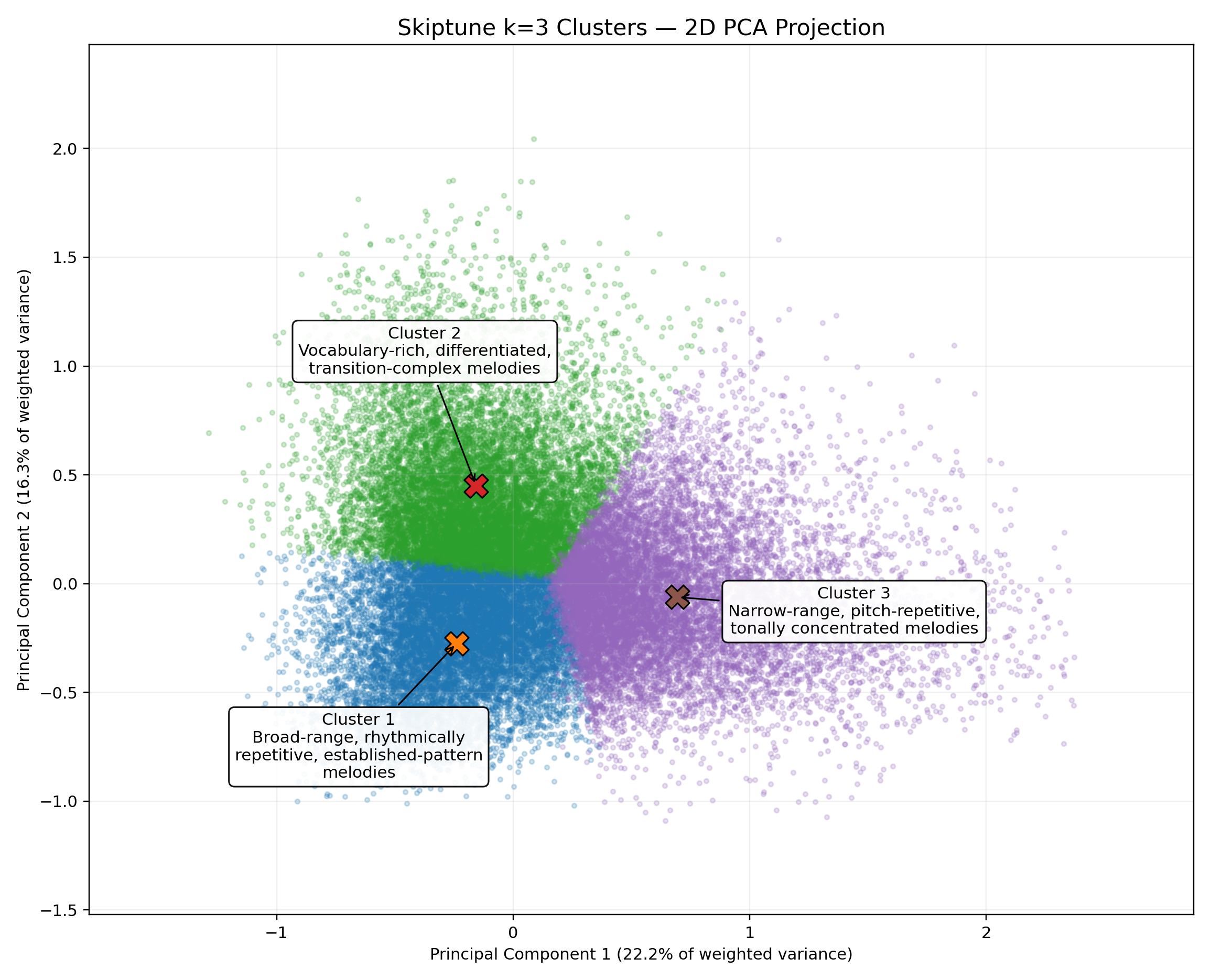
We emphasize that this two-dimensional drawing is a conflation of a many-dimensional drawing that we simply can’t visualize even using our imagination. The point to take away is that there are three clusters with certain attributes that distinguish themselves, and that they are roughly the same “distance” from each other.
Identifying the Three Clusters
The three clusters that emerged from the analysis are distinct from each other by virtue of the metrics used to identify them in the first place. We’ll examine each in turn, starting from the blue cluster in the figure (lower left) and moving clockwise.
Cluster 1–Rhythmic Landscapes
Cluster 1 (blue in the figure) contains tunes that are broad-ranging, are rhythmically repetitive, have relatively extensive pitch movement and range, and tend to use familiar melodic patterns. A total of 46 percent of the tunes in the database fall into this cluster.
Several representative tunes near the cluster centroid are:
- The Old Coolin
- Un poco Vivace, from Il pastor fido, Sonata V
- I’m Seventeen Come Sunday
- Lady Coventry’s Delight
- Ash Grove
The representatives span traditional melodies, dance music, and instrumental compositions. That variety is important because he clustering is detecting numerical features of melody, not a conventional stylistic or historical category.
Cluster 1 seems to capture longer melodies that reuse recognizable musical material while moving through a relatively substantial pitch range. Its high duration repetition suggests rhythmically consistent passages. At the same time, its pitch movement is not especially restricted.
It is hard to tell if these features are the results of phrase repetition, sequential development, or recurring rhythmic figures. The aggregate statistics cannot distinguish among those possibilities.
Cluster 2–Kaleidoscope Invention
Cluster 2 (green in figure) comprises about 31 percent of the tunes in the database and carried the following features: Vocabulary-rich, varied, less-repetitive melodic vocabulary with greater diversity of pitches, pitch intervals, and rhythmic relationships, with fewer recurring patterns.
It is characterized by the greatest normalized diversity of pitches, pitch differentials, and duration ratios. It also has the highest fraction of single-occurrence patterns and the lowest rate of repeated durations.
Representative titles include:
- At a Georgia Camp Meeting
- Scotch Tune in Fashion
- My Love’s Like the Red, Red Rose
- Lady Montegle’s Paven
- I’m Looking Over a Four Leaf Clover
On first inspection, this appears to be the most varied or least repetitive type of melody.
However, a critical qualification is that these tunes are substantially shorter than those in Cluster 1. In a short melody, a relatively small number of distinct pitches or rhythmic relationships can produce a high normalized diversity score.
Consequently, it would be premature to describe Cluster 2 as musically more sophisticated. Its high diversity measurements may arise partly because short melodies provide fewer opportunities for patterns to recur.
Cluster 3–Melodic Mantras
Cluster 3 (purple in the figure) is the smallest, making up only 23 percent of the database tunes. These tunes are arrow-ranging, pitch-repetitive melodies
with extensive repetition of individual pitches, comparatively small intervals, restricted pitch range, and less evenly distributed pitch classes.
Compared with Cluster 1, it has over four times the percentage of repeated pitches, about one-third less average relative pitch movement, a substantially narrow pitch range, lower pitch-class entropy, and more frequent 3-note palindromes.
Representative examples include:
- I Ain’t Broke But Brother I’m Badly Bent
- Have a Little Dog
- Please Come to Boston
- Do Wah Diddy Diddy
- Sacramento
Cluster 3 looks like a family of melodies that rely more heavily on pitch repetition and restricted melodic movement.
Putting Numbers on Those Features
The cluster analysis produces a table of how selected metrics panned out with respect to each cluster, and we include it here for completeness, but the percentages are rounded to the nearest whole percent:
Differences in the musical characteristics
| Metric | Cluster 1 | Cluster 2 | Cluster 3 |
| Pitch range (semitones) | 18 | 15 | 12 |
| Repetitive pitches (%) | 8 | 9 | 32 |
| Repetitive durations (%) | 61 | 38 | 46 |
| Three-note palindromes (%) | 12 | 7 | 14 |
| Normalized different pitches (%) | 18 | 32 | 18 |
| Normalized pitch differentials (%) | 19 | 35 | 23 |
| Normalized duration ratios (%) | 10 | 24 | 17 |
| Pitch-class entropy (%) | 76 | 74 | 65 |
We’ll give one example from each cluster to show how this table yielded the descriptions or features we gave the three clusters:
- Cluster 1 has tunes where 61 percent of the durations repeat themselves immediately, where the other two clusters have 38 and 46 percent doing so. This feature led to the name “Rhythmic Landscapes for this cluster.
- Cluster 2 has tunes with 32 percent normalized different pitches, 35 percent pitch differentials and 24 percent normalized duration ratios, the highest of the three clusters in those categories. The other clusters show percents in the teens or low 20s. The wide variety of both pitch differentials and duration ratios results in a varied, rich vocabulary that inspired us to call this cluster “Kaleidoscope Invention.”
- Cluster 3 has tunes where, on average, 32 percent of the pitches immediately repeat, whereas the other two clusters have just 8 and 9 percent of their notes doing so. That is what led us to call this cluster “Melodic Mantras”.
Conclusion
That concludes the summary of the cluster analysis, but we return next week to point out some problems we uncovered in performing this work.