A few tunes stand out from all the other tunes in the database because they take on some extreme values in our metrics. The tune that distinguishes itself the most in terms of a large number of unique patterns is part of the development section in the first movement of Beethoven’s Fourth Symphony, written in 1808. The notes and patterns in question are shown here:
A portion of Beethoven’s Symphony #4, first movement’s development section
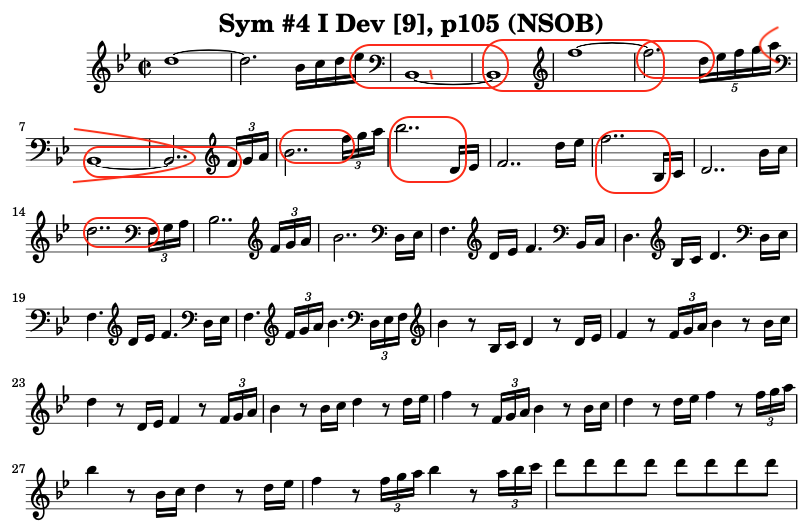
The encircled notes are two-note patterns that are unique in the Skiptune database. There are nine of them in all, and that’s the most number of unique patterns in a single entry in the database. Notice that most of the two-note patterns circled in red contain pitch changes of more than an octave (several move back and forth from the bass clef to the treble clef). Such large intervals are common in orchestral music, so it’s not surprising that it is an orchestral piece with the most number of unique two-note patterns.
By way of comparison, another tune in the database with a large number of unique patterns is Souvenir des Alpes (Op. 31, #6) by Theobald Bohm in 1852. The tune can be listened to and its sheet music observed here on the Flutetunes website. Romantic era tunes often contain new patterns, but Souvenir des Alpes distinguishes itself from all melodies written before the jazz era by having five unique patterns.
To be fair, the idea of counting unique two-note patterns in tunes depends a lot on the length of the melody in question. We divide works up into individual sections, generally whenever they have completed a musical thought or melody and have moved on to a new one. Some pieces, however, are one long melody and have a greater chance of containing unique patterns. For example, Indian Love Call, written in 1924. The piece is an american show tune from an operetta, and enjoyed fame as a pop ballad in both film and television. We did divide Indian Love Call into a few sections, but if we were to enter it as one long piece, it might contain more unique two-note patterns than even the Beethoven piece shown above, which itself is part of a much longer work.
Because of this arbitrary feature, we do not use the number of unique patterns as a metric. Few tunes have any two-note unique patterns, which makes it too sparse a metric to be useful. It’s still interesting, and that’s why we’ve placed it in Musical Musings.