Extremely Rarely Used Patterns
This page documents two-note patterns that are extremely rare given their simple structure. Elsewhere we define such surprisingly rare patterns as those occurring in fewer than 30 tunes in the Skiptune database and meeting the other criteria. For each pattern we show:
⇒ The duration ratio in integer form as a fraction
⇒ The number of tunes in which the duration ratio was found in the database, including those involving rests
⇒ The chronological first instance of a duration that we can find in our database, but avoid those involving rests unless they are interesting.
⇒ The fractional form of the duration ratio and a verbal description of the notes needed to form that duration ratio
⇒ Examples of tunes from each century in which we have an instance of this duration ratio’s use. Each instance ends with how the duration ratio is calculated with the notes shown.
⇒ A list of intervals, within an octave around unison, that have been used to date with this duration ratio
Example E1: 13.333 Duration Ratio, 4 tunes
How Formed: 40/3 ratio, such as a sixteenth note followed by a dotted half note tied to an eighth note triplet.

Although this duration ratio meets our criterion of using only one tie, it’s hard to form without using tuplets of some kind and therefore we wouldn’t expect to find many in the database. The first instance of its use was in Chopin’s Nocturne No. 1, Op. 9, written in 1831. Shown at the left, the duration ratio was formed with only two notes, an eighth note and a half note, but Chopin enclosed the eighth note in a 20-note tuplet that was squeezed into the space of a normal set of six eighth notes. This calculation is complicated and is a good example of the kind of pattern that could only be found by a computer. First, we need to calculate the value of the eighth note in the tuplet. Because 20 eighth notes are squeezed into the duration of only 6 eighth notes, the value of each tuplet eighth is 6/20 times the normal value of an eighth note, which is two. So 2 * (6/20) = 0.6 . The rest of the duration ratio calculation is straightforward: 8 / 0.6 or 13.333.
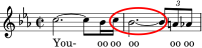
A version of The Indian Love Call–a song popular in the musical Rose Marie in 1936 but which now would be considered schmaltzy–contains the 13.333 ratio in the form of a sixteenth note followed by a dotted half note tied to an eighth note triplet. The interval used by composer Rudolf Friml was a major second. Given how difficult it is to form this duration ratio, we do not expect the 13.333 duration ratio to ever leave the “extremely rare” category, even after adding thousands of more songs. Calculation: (12 + 1.333) / 1 = 13.333.
Intervals plus or minus an octave for duration ratio 13.333 found in the database (MIDI values):
-2, unison, +2, +3.
Example E2: 0.321 Duration Ratio, 10 tunes
How Formed: 9/28 ratio, such as a triplet eighth note tied to a half note and followed by a dotted eighth note.

All uses of the 0.321 duration ratio are from the 20th century. A 9/28 ratio does not seem as though it would be common, but when viewed in music notation it’s surprising we don’t see it more often. The tunes are all show tunes, film, or jazz pieces: Isn’t It a Pity (Gershwin show tune from 1921), Willow Weep for Me (jazz tune, 1932), Shanghai Lil (film, 1933), Two Sleepy People (show tune, 1938), and in the example to the left, The Object of My Affection (show tune, 1934). Another tune is from the andante maestoso, Brigadoon (show tune, 1947). All known instances use the same formation of a triplet eighth note tied to a half note followed by a dotted eighth note. Calculation: 3 / (1.333 + 8) = 0.321.
Intervals plus or minus an octave for duration ratio 0.321 found in the database (MIDI values):
-7, -1, unison, +1, +4, +5, +10.
Example E3: 6.75 Duration Ratio, 26 tunes
How Formed: 27/4 ratio, such as a triplet quarter note followed by a whole note tied to an eighth note.

The 6.75 duration ratio was first used in the database in a baroque piece, a toccata by Johann Jakob Froberger, taken from his Libro secondo and published in 1649 (see music snippet at left). He forms the pattern with an eighth note followed by a half note tied to a sixteenth note, using a major second interval. Calculation: (12 + 1) / 2 = 6.75.

The 6.75 duration ratio was later used in the baroque period in a tune called Fly Swift ye Hours in Henry Playford’s Banquet of Music, published in 1692. This instance of the 6.75 duration ratio is formed by a half note “A” followed by an “F” note consisting of two dotted whole notes tied to a dotted quarter note (a minor sixth interval, +MIDI 8). It may not be surprising that this duration ratio is rare, given this construction, but as we shall see later there is at least one easier way to create it. Calculation: (24 + 24 + 6) / 8 = 6.75.
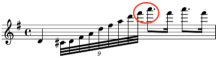
We don’t find an instance of the 6.75 duration ratio in the 1700s, so we jump to our next instance in the 1875 Overture to Orpheus in the Underworld by Carl Binder, shown at the left. Again, we have a complicated formulation, this time using a 9-note tuplet of 32nd notes followed by a dotted eighth note. If these first two instances were our only examples of the 6.75 duration ratio, we would probably have not have included it in our list of surprisingly rare duration ratios. The interval for this instance is a minor third (+3 MIDI). Calculation: 3 / (0.5 x 8/9) = 6.75.

This duration ratio has been used only a few times, and we leap forward 100 years to cite our next instance, Till There Was You from The Music Man (1950) by Meredith Wilson. The interval is a major second downward (-2 MIDI) and the formation is a triplet quarter note followed by a whole note tied to an eighth note. This formation doesn’t appear as though it should be as rare as it is, so we are surprised that it has been used in only a handful of tunes. Calculation: (16 + 2) / (4 x 2/3) = 6.75.
Intervals plus or minus an octave for duration ratio 6.75 found in the database (MIDI values):
–5, -2, -1, unison, +1, +2, +3, +4, +5, +6, +7, +8, and +11.
Example E4: 13.5 Duration Ratio, 26 tunes
How Formed: 27/2 ratio, such as a triplet eighth note followed by a whole note tied to an eighth note.

We found the first instance of the 13.5 duration ratio in the Musette en Rondeau by Jean Philippe Rameau in 1724, just as the baroque era was giving way to the classical period. He formed it (see the left music snippet) with a triplet eighth note jumping up a minor 7th to a dotted half note tied to a dotted quarter note. Calculation: (12 + 6) / 1.333 or 13.5.

Nearly a century later, Friedrich Kuhlau used the 13.5 duration ratio in the adagio from his Trois Grands Solos No. 1, Op. 57 in 1810. Shown at the left, the 13.5 duration ratio is achieved by following a triplet 32nd note with a quarter note tied to a 32nd note. Calculation: (4 + 0.5) / (0.5 x 2/3) = 13.5.

The next time we see this interval chronologically is in Tchaikovsky’s Nutcracker Suite, Scene 6, in 1892, roughly 80 years later than its first use. The interval is a rare augmented fourth, which Tchaikovsky used as he shifted between the treble and bass clefs while he was ending this dance. Calculation: (8 + 1) / (1 x 2/3) or 13.5.

Tchaikovsky again used the 13.5 duration ratio just four years later in the Olympic Hymn, unveiled in 1896 at the summer olympics in Athens, Greece. (Its status as the ‘official’ olympics hymn wasn’t conferred until much later in 1958.) The 13.5 duration ratio, though twice as large as the 6.75 duration ratio and therefore expected to be rarer, has been used about the same number of times in the database. Calculation: (16 + 2) / 1.33 or 13.5.

The 13.5 duration ratio is used in only a few additional tunes in the ensuing years: 1928’s Creole Love Call, 1930’s Sleepy Lagoon, and 1947’s Stormy Monday. We show the excerpt from Sleepy Lagoon at the left because it uses a slightly different formation from the one used in The Olympic Hymn, Creole Love Call, and Stormy Monday. In Sleepy Lagoon, the triplet eighth note is followed by a dotted half note timed to a dotted quarter note (rather than a whole note tied to an eighth note). Calculation: (12 + 6) / 1.33 or 13.5.
Intervals plus or minus an octave for duration ratio 13.5 found in the database (MIDI values):
-5, -2, -1, unison, +1, +2, +3, +4, +6, +7, and +10.
Example E5: 0.563 Duration Ratio, 6 tunes
How Formed: 9/16 ratio, such as a triplet eighth note tied to a quarter note and followed by a dotted eighth note.

The earliest instance of the 0.563 duration ratio in the database is from the opening measures of a toccata in Johann Jakob Froberger’s Libro secondo published in 1649. Shown at the left circled in red, the notes used are a whole note followed by a same-pitched half note tied to a sixteenth note. Calculation: (8 + 1) / 16 or 0.563.
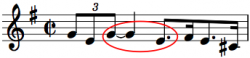
Curiously, we don’t see this duration ratio again until the jazz era. At the left is an instance in a song called Why Don’t You Do Right?, written by Joe McCoy in 1941. The tune, a swing from the big band era, became a pop and jazz standard that was eventully used in film and even a video game. This instance of the 0.563 duration ratio uses a minor third downward in pitch, and is formed with a tied eighth note triplet followed by a dotted eighth note. Calculation: 3 / (1.333 + 4) or 0.563

Our next instance is from 1955 in the light jazz tune, Alright, Okay, You Win, written by Mayme Watts and made famous by singer Peggy Lee. The variation on that tune shown at the left contains the 0.563 duration ratio with a minor second pitch change. The 0.563 duration ratio is also found in All the Way from the film, The Joker Is Wild and in Talk to Me, another jazz tune, as well as An American in Paris (1928). Outside the first instance in the 1600s, this pattern has not been found outside the jazz genre thus far. Calculation: 3 / (1.333 + 4) or 0.563.
The intervals, plus or minus an octave, for duration ratio 0.563 found in the database (MIDI values):
-3, +1, +2, and +7.
Example E6: 0.176 Duration Ratio, 25 tunes
How Formed: 3/17 ratio, such as a whole note tied to a sixteenth note followed by a dotted eighth note.
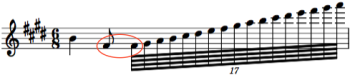
The first use of the 0.176 duration ratio is in Tchaikovsky’s Sleeping Beauty Ballet, written in 1889. We find it in the measure at the left in the andante movement of the finale from Scene No. 4 in the prologue. The formation of the duration uses only two notes, but it achieves the 0.176 ratio by including one of the notes in a 17-note tuplet. There is no pitch change between the two notes. Remember that a 64th note is worth 0.25 in our duration value system. Calculation: (24/17 x 0.25) / 2 or 0.176.

The 0.176 duration ratio was only used a handful of times in the 20th century, one of which is shown at the left, Duke Ellington’s Warm Valley, written in 1941. The interval is a minor second. Unlike the previous instance, this formation’s calculation is straightforward. Calculation: 3 / (1 + 16) or 0.176. So far this duration is extremely rare and mostly used in the jazz era. It remains to be seen if it is picked up by other composers as time goes on. In the vast majority of cases so far, use of this duration ratio involves a long rest.
Intervals plus or minus an octave for duration ratio 0.176 found in the database (MIDI values):
–7, -5, -3, -1, unison, +1, +2, +4, and +5.
Example E7: 0.533 Duration Ratio, 11 tunes
How Formed: 8/15 ratio, such as a dotted half note tied to a dotted eighth note followed by a half note.

The 0.533 duration ratio was first used just over 100 years ago in 1895 in a song called Deserted Farm by American composer Edward MacDowell. At this time we were at the end of the romantic period and beginning to transition to the modern. Shown at the left, MacDowell the 0.533 duration ratio occurs in measures 4 and 5 with a dotted eighth note tied to a dotted half note that is followed by another dotted half note The interval is a descending perfect fourth. Calculation: 8 / (3 + 12) or 0.533.

There is a 1917 use involving rests in Gesu Bambino, an Italian Christmas carol that is not shown here. Its first use in the modern era is in the 1941 jazz song, “Take the ‘A’ Train” by Billy Strayhdorn. Shown at the left, the formation appears in the opening bars and its multiple ties perhaps suggest why this formation wasn’t used until relatively recently. The interval is a major second. Calculation: 16 / (6 + 8 +16) or 0.533.

We also find the 0.533 duration ratio in Leonard Bernstein’s introduction and opening bars of “Somewhere” from West Side Story in 1957. Here, the formation is the same as that used in the 1895 song cited above, this time with a perfect fifth descending in pitch. Calculation: 8 / (3 + 12) or 0.533.

In 1965 the Beatles found yet another way to use the 0.533 duration ratio in We Can Work It Out, shown at the left. Here, Lennon and McCartney used a sixteenth note tied to a quarter note and followed those with a quarter note triplet. This formation only exists because Lennon and McCartney added a very unusual interval, the major seventh, to this rarely used formation to form the hummable triplet tag at the every end of the song. Calculation: (2.667 / (1 + 4) or 0.533.
Intervals plus or minus an octave for duration ratio 0.533 found in the database (MIDI values):
-11, -7, -5, -2, unison, +1, +3, and +6.
Example E8: 0.296 Duration Ratio, 1 tune
How Formed: 8/27 ratio, such as a dotted whole note tied to a dotted eighth note followed by a half note.
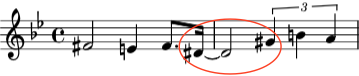
Amazingly, the database contains only one instance of the 0.296 duration ratio and that in the Duke Ellington song, Warm Valley, a tune written in 1941 that’s popped up several times with surprisingly rare duration ratios (see the entries for duration ratios 6.667 and 0.176). Ellington forms the 0.296 duration ratio with a sixteenth note tied to a half note and followed by a quarter note triplet, using a perfect fourth interval. Calculation: 2.667 / (1 + 8) or 0.296.
Intervals plus or minus an octave for duration ratio 0.296 found in the database (MIDI values):
+5
Example E9: 9.75 Duration Ratio, 7 tunes
How Formed: 39/4 ratio, such as a triplet eighth note followed by a dotted half note tied to a sixteenth note.

The 9.75 duration ratio is formed with successive notes with a duration ratio of 39/4, so the extreme difference in the numerator and denominator of this ratio suggests a modern invention. This is indeed the case. The first instance of this duration ratio we found is at the end of the refrain in Love Nest, a show tune written in 1920 by Louis A. Hirsch for the musical comedy, “Mary.” Hirsch forms this ratio with a major second interval using a quarter note triplet followed by a whole note tied to a half note tied to an eighth note. Calculation: (16 + 8 = 2) / 2.67 or 9.75.

The Hirsch formulation used a double tie, but John Coltrane employed the 9.75 ratio in 1965 using a single tie in his jazz tune, Central Park West in 1965, shown at the left. Here, an eighth note triplet is followed by a dotted half tied to a sixteenth note with a major second interval. Calculation: (12 +1) / 1.333 or 9.75.
Intervals plus or minus an octave for duration ratio 9.75 found in the database (MIDI values):
-2, -1, unison, +2, +4, +5, and +8.
Example E10: 1.875 Duration Ratio, 17 tunes
How Formed: 15/8 ratio, such as a half note followed by a dotted half note tied to an eighth note.

The first instance found of the 1.875 duration ratio appeared around 1712 in the sixth movement of the fifth suite in the series of Concerts for Two Flutes by Frenchman Michel Pignolet de Montéclair (1667 – 1737). The exact date of composition is unknown, so we are using the midpoint of his adult life. Montéclair formed this duration ratio by following a half note by a dotted half note tied to a dotted eighth note, all with a fourth interval jump. Calculation: (12 + 3) / 8 or 1.875.

In the next century we find use of the 1.875 duration ratio with a rest in Tchaikovsky’s Mignon’s Song, Op. 25, written in 1875. This pattern appears as though it would be quite common, but it clearly is not, though we have no doubt that as we enter more tunes we will find more examples. Tchaikovsky achieves the duration ratio coming from a half note rest to a dotted half note F tied to a dotted eighth note F. Tchaikovsky returned to this duration ratio twice in the Nutcracker Suite (the Grandfather Waltz scene and the allegro in Clara and the Nutcracker. Calculation: (12 + 3) / 8 or 1.875.

We find it without rests in 1883 in the so-called Sunrise Theme from Also Sprach Zarasthustra by Richard Strauss, shown at the left. These are the opening bars from that famous theme and Strauss achieves the 1.875 duration ratio using a perfect fourth in going from a half note to a half note tied to a double dotted quarter note. He uses this exact formulation with different notes twice more in this short piece. The calculation is (8 + 7) / 8 or 1.875.
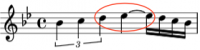
We only find the 1.875 duration ratio used a few more times in our database, all in the 20th century. Our example comes from the 1965 instrumental piece, Il Silenzio (The Silence), written by Nini Rosso and Guglielmo Brezza. They used a quarter note triplet followed by a quarter note tied to a sixteenth note, employing a minor second interval. The calculation is (4 + 1) / 2.667 or 1.875.
Intervals plus or minus an octave for duration ratio 1.875 found in the database (MIDI values):
-2, -1, +1, +2, +5, and +7
Example E11: 0.688 Duration Ratio, 8 tunes
How Formed: 11/16 ratio, such as a whole note followed by a half note tied to a dotted eighth note.

The 0.688 duration ratio is another of those that appear as though they should be much more common than they are. The first instance we found was in 1712 in Benedetto Marcello’s Adagio I from Recorder sonata No. 1 in F, Op. 2. Marcello used a half note followed by a quarter note tied to a dotted sixteenth note. There is no pitch change. Marcello used this duration ratio in several of his sonatas, but few composers after him employed it. Calculation: (4 + 1.5) / 8 or 0.688.

We don’t find the 0.688 duration ratio in the 1800s at all. Our instance in the 20th century comes from I Don’t Want to Walk Without You from Sweater Girl, a song by Jule Styne in a 1942 film about college kids putting on a show while solving a series of murders. Styne uses a minor sixth interval, itself unusual, in a whole note followed by a half note tied to a dotted eighth note. Calculation: (8 + 3) / 16.
Intervals plus or minus an octave for duration ratio 0.688 found in the database (MIDI values):
Unison, +5, +7, and +8.
Example E12: 1.714 Duration Ratio, 7 tunes
How Formed: 12/7 ratio, such as a dotted eighth note tied to a quarter note and followed by a dotted half note.
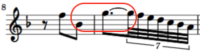
The 1.714 duration ratio is another example of a simple-looking pattern that is rarely used by composers of any genre. However, the first instance of it is complicated. We find it in an old English folk song called “Wou’d you gain the tender” from the tune book, “Calliope or English Harmony, published in 1739. The 1.714 duration ratio occurs from an eighth note passing to a dotted eighth note tied to a 32nd note in a 7-note tuple–not a very simple configuration. Calculation: (3 + 6/7 * 0.5) / 2 or 1.714. The 32nd note has a raw value of 0.5, but has only 6/7 of that value in the tuple.
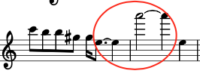 In the 19th century we have a quite different formation of the 1.714 duration ratio that uses a dotted eighth note tied to a quarter note that’s followed by a dotted half note. The interval is large: 17 steps. This formation is in the Peer Gynt Suite by Edvard Grieg, notably his “Solvejg’s Song,” a popular piece played by orchestras, originally composed by Grieg in 1875. Calculation: (8 + 4) / (3 + 4) or 1.714.

We find another instance of the 1.714 duration ratio almost two centuries later in “Greens,” an African American tune. The formation does require a Scotch snap followed by a longer note, and snaps are relatively uncommon, so in that sense the rarity of the 1.714 duration ratio is more understandable, but we still are surprised at how rare it is. “Greens” was first written down in 1927, but is likely older. The anonymous composer tied a dotted eighth note to a quarter note followed by a dotted half note with a major second interval downward. Calculation: 12 / (3 + 4) or 1.714.
Intervals plus or minus an octave for duration ratio 1.714 found in the database (MIDI values):
-2, +9
Example E13: 6.667 Duration Ratio, 27 tunes
How Formed: 20/3 ratio, such as a dotted eighth note followed by a dotted half note tied to a half note.

The first unique use of the 6.667 duration ratio was formed in 1869 by Brahms in his Hungarian Dance No. 6 in D♭, WoO 1, and shown at the left. (Telemann used this duration ratio with rests in 1727 and Schumann used it in 1840 that foreshadows uses in the 20th century.) Once again, Brahms does it the hard way by using a 32nd note tuple followed by an eighth note, though this allows him to achieve the 6.667 duration ratio with only two notes. Calculation: 2 / (0.5 x 0.6) or 6.667.

The 6.667 duration ratio was used roughly a dozen times in the 20th century, and three of them were in on piece, Warm Valley, a Duke Ellington jazz standard. Shown at the left, Ellington used the formation of an eighth note followed by a dotted half note tied to an eighth note triplet. Ellington uses this formation three times with three different intervals in Warm Valley. The calculation is (12 + 1.333) / 2 or 6.667.

There’s an even easier way to form this duration ratio without the use of triplets. At the left is Maurice Williams’s doo-wop song, “Stay,” from 1960. Williams uses a sixteenth note followed by a dotted half note tied to a half note with no pitch change. Calculation: (12 + 8) / 3 or 6.667.
Intervals plus or minus an octave for duration ratio 6.667 found in the database (MIDI values):
-5, -4, -3, -2, -1, unison, +1, +2, +3, +5, and +12.
Example E14: 8.25 Duration Ratio, 29 tunes
How Formed: 33/4 ratio, such as an eighth note followed by a dotted half note tied to a quarter note tied to a 32nd note.
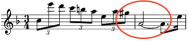
The 8.25 duration ratio was first used in a Bach courante in 1720 from his Partita No. 2 in Dm for solo violin, BWV 1004. Bach uses this duration ratio twice in this piece. The first time is with a major seventh interval (-11 MIDI), shown at the left, and the second time with a major second interval (+2 MIDI) at the very end of the piece. In both instances the formation is an eighth note triplet followed by a half note timed to a dotted eighth note. Calculation: (8 + 3)/1.333 or 8.25.

A century and a half later Debussy used this duration ratio in his impressionistic Prelude to the Afternoon of a Faun, written in 1894, shown at the left. His formation consists of a simple eighth note followed by a dotted half note tied to a quarter note tied to a 32nd note. Because Debussy painstakingly wrote out precisely how he wanted his pieces to be played, he has a lot of unusual and rarely used duration ratios and patterns, of which this is one example. Calculation: (12 + 4 + 0.5) / 2 = 8.25.

Our last example is from a rock tune, I Will Follow Him, by Little Peggy March in 1963. The 8.25 duration is formed with notes that each are double the value shown in our first example, the Bach courante. The interval used is a perfect fourth (+5 MIDI). It is easy to understand why the 8.25 duration ratio is uncommon. The formations are necessarily complicated in order to reach the required ratio of 33/4 duration values. Calculation: (16 + 6) / 2.667 or 8.25.
Intervals, plus or minus an octave, for duration ratio 8.25 found in the database (MIDI values):
-11, -3, -2, -1, unison, +1, +2, +4, +5, and +7.
Example E15: 16.5 Duration Ratio, 11 tunes
How Formed: 33/2 ratio, such as two whole notes and a quarter note, all tied, followed by an eighth note.

The first instance we see in the database of the 16.5 duration ratio is in the L’Auguste allemande in G minor by Francois Couperin, circa 1713. The formation is a complicated one, consisting of a triplet 32nd note followed by a quarter note tied to a dotted 16th note. As we shall see, composers find far simpler ways to achieve this unusual duration ratio in later centuries. Calculation: (4 + 1.5) / 0.333 or 16.5.

Not finding any instances during the classical period, we jump to the late romantic era to find the 16.5 duration ratio used in Philippe Gaubert’s Nocturne, which he wrote in his Nocturne et Allegro Scherzando piece in 1906. He uses the exact same formulation as Couperin, but with an upward interval of a minor third. Calculation: (4 + 1.5) / 0.333 or 16.5.

Our final example of the 16.5 duration ratio uses a quite different formulation from the first two. Shown at the left is a portion of Brazil by Ary Barroso, a popular and still well-known Latin tune from 1939. Barroso created the pattern with a quarter note followed by an eighth note tied to a series of four whole notes. Calculation: {2 + 16 + 16 + 16 + 16) / 4 or 16.5
Intervals, plus or minus an octave, for duration ratio 8.25 found in the database (MIDI values):
-5, -4, -2, unison, +1, +2, and +3
Example E16: 0.094 Duration Ratio, 13 tunes
How Formed: 3/32 ratio, such as a dotted eighth note followed by a whole note tied to another whole note.

While the 0.094 duration ratio was used as early as the 1600s incorporating rests, it was not until Handel’s Messiah in 1741 that it was used in note patterns. Shown at the left is the first example found, that in “I Know That My Redeemer Liveth” in Part Three of The Messiah. The formation doesn’t strictly qualify as it contains two ties, but a later example shows a simpler formulation. The interval is a major second upward in pitch. Calculation: 3 / (12 + 12 + 8) or 0.094.

We skip over a 19th century example using rests to jump to a jazz tune called Orbits, written in 1967 and shown at the left. The composer, Wayne Shorter, used a minor third interval (downward in pitch) from a half note triplet tied to a whole note and followed by an eighth note. This formation is also not simple, but it does cross our threshold of having no more than one consecutive tie. Calculation: 2 / (5.333 + 16) or 0.094.

Our simplest example shows up the next year, 1968, in a Peter, Paul, & Mary tune called She Dreams. Here the 0.094 duration ratio is simply formed by two tied whole notes followed by a dotted eighth note. The interval is major third upward in pitch. Given this simple formation, it is surprising we do not see it until 1968. Calculation: 3 / (16 + 16) or 0.094.
Intervals, plus or minus an octave, for duration ratio 0.094 found in the database (MIDI values):
-10, -3, unison, +2, +3, and +5.
Example E17: 3.111 Duration Ratio, 4 tunes
How formed: 28/9 ratio, such as a quarter note in a four-note tuplet followed by a half-note tied to an eighth note triplet.

There are only a handful instances of the 3.111 duration ratio, all in the 1900s. The one shown here is in Steve Swallow’s jazz tune, “Arise, Her Eyes,” written in 1969. While the formation of this duration ratio technically qualifies as a ‘surprisingly rare’ pattern, its form does not lead one to expect to see many more examples, even as we enter more melodies. We had to wait for the jazz era to produce a pattern in a tune written in 3/4 time containing a measure stretching out four notes to fit in three counts, followed by a measure with a tied triplet. We’re not holding our breath for many repeats. Calculation: (8 + 1.333) / 3 = 3.111.
Intervals, plus or minus an octave, for duration ratio 3.111 found in the database (MIDI values):
-5, -1, and +1
Example E18: 0.917 Duration Ratio, 21 tunes
How Formed: 11/12 ratio, such as a dotted half note followed by a half note tied to a dotted eighth note.

This duration ratio was first used by Henry Purcell in a ground he wrote in 1680. Shown at the left, this particular variation on the ground (the sixth in the piece) achieves a 0.917 duration ratio with a dotted half note followed by a half note tied to a dotted eighth note. The interval is a major second going downward in pitch (-2 MIDI). Calculation: (8 + 3) / 12 or 0.917.
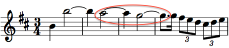
We find this duration ratio used by Quantz in his Tempo di Minuetto from Duet #3 in Bm, QV 3:2 by Quantz, the flute composer, in 1759. The instance shown is for the first flute part, but the pattern is also used in the second flute part. Although this duration ratio is easily formed, it requires an 11/12 ratio that composers have apparently not found all that useful in their compositions. Calculation: (8 + 3) / (8 + 4) or 0.917.

We found this duration ratio used again in a variation on an Irish folk tune called Pretty Girl Milking the Cow, a song captured by Edward Bunting, the famous Irish musician and folk music collector. Formed by a dotted quarter note followed by a quarter note tied to a dotted 16th note, the ratio of note durations here is 5.5/6, which is equivalent to 11/12. Although this tune was first published in 1809 by Bunting, the tune itself is probably considerably older. Because exactly when it was written is lost to history, we use its first publication date as a substitute. Calculation: (4 + 1.5) / 6 or 0.917.

Our 20th century instance of the 0.917 duration ratio comes from Victor Herbert’s tune, A Kiss in the Dark, written in 1922 and shown at the left. Herbert uses this duration ratio a number of times with a variety of intervals toward the end of his tune, three instances of which are shown at the left. It’s almost as if Herbert, having stumbled on an interesting and little-used note combination, decided to exploit it in this tune. All his formulations are the same. Calculation: (8 + 3) / 12 or 0.917.
Intervals plus or minus an octave for duration ratio 0.917 found in the database (MIDI values):
-10, -8, -5, -4, -3, -2, -1, unison, +1. +2, +3, +4, +5, +6, +7, +8. and +9.
Example E19: 0.19 Duration Ratio, 24 tunes
How Formed: 4/21 ratio, such as a dotted eighth note tied to a quarter note and followed by an eighth note triplet.
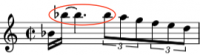
The 0.19 duration ratio was first used in 1764 in Mozart’s Allegro I from the Sonata No. 5 in C major, K. 14. Mozart achieved the 0.19 duration ratio with a sixteenth note tied to a dotted quarter note and followed by an eighth note triplet. Calculation: 1.33 / (1 + 6) or 0.19. We could not find an example of this duration ratio in the 1800s, but that may just mean that we need to enter more tunes into the database. Rarely is a duration ratio discovered and then not reused in the next hundred years by somebody, so we are confident that we will find a romantic era instance eventually. Calculation: 1.333 / (1 + 6) or 0.19

This next instance is in Beethoven’s Fourth Symphony, second movement intro. It is formed with no interval change by tying a dotted half note with an eighth note followed by an eighth note tied to a sixteenth note in a triplet. This is quite a complicated set of notes and we don’t expect to see it again with other intervals. Calculation: (2 + 0.667) / (12 + 2) or 0.19.
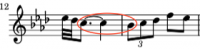
The next use was in 1907 in Ravel’s Vocalise-Etude en forme de Habanera, an piece Ravel meant as an etude but which gained popularity as a performance piece over time. The formation Ravel used is similar but not identical to that of Mozart. The two tied notes are a dotted eighth and a quarter note, but the value in duration is still seven, so the calculation is otherwise the same as the Mozart instance. The 0.19 duration ratio was used again by Leonard Bernstein in Somewhere from West Side Story; Bernstein used the same formation as Mozart but with each note doubled in duration value. Calculation: 1.333 / (3 + 4) or 0.19.
Intervals plus or minus an octave for duration ratio 0.19 found in the database (MIDI values):
-3, -2, -1, unison, +2, +3, +5, +8, and +9.
Example E20: 1.833 Duration Ratio, 28 tunes
How Formed: 11/6 ratio, such as a dotted quarter note followed by a half note tied to a dotted eighth note.

The first us of a series of notes using a 1.833 duration ratio occurred around 1682 in Dietrich Buxtehude’s Canzonetta (BuxWV 171). We don’t know the exact year when Buxtehude wrote this piece, so we estimate 1682 using the mid-point of his adult life. Shown at the left is a snippet of the Canzonetta, appearing toward the end of the piece, containing this duration ratio. Calculation: (2 + 6 + 3) / (2 + 4) or 1.833.

We skip to the 19th century to find an instance from measures 36 and 37 in the intermezzo allegro from Brahms’s Balladen 3, Op. 10, shown at the left. The melody at this point in the piece is written in the bass clef. Calculation: (12 + 6 + 4) / 12 or 1.833.

The 1.833 duration ratio was used in 1947 in a pop song called Stormy Monday by the Allman Brothers, written by Aaron Walker. Like Haydn, Walker used a dotted half note followed by rests t form the duration ratio, but of course the styles couldn’t be more different–a classical liturgical piece versus a rhythm and blues song. Stormy Monday uses this duration ratio three times. Calculation: (4 + 16 + 2) / 12 or 1.833.
Intervals plus or minus an octave for duration ratio 1.833 found in the database (MIDI values):
-5, -4, -2, unison, +1, +2, +3, +4, +5, and +7.
Example E21: 0.148 Duration Ratio, 27 tunes
How Formed: 4/27 ratio, such as an quarter followed by a dotted whole note tied to a dotted eighth note.

The 0.148 duration ratio makes its first appearance in the database in the duet, Act 2, of Bizet’s Carmen, shown at the left. This instance from 1817 involves rests, as does the next one, but both are from well-known pieces so we include them. Here, Bizet follows a rest of duration 9 (1 for the 16th rest, and 4 each for the quarter rests) by an eighth note triplet. Calculation: 1.333 / (1 + 4 + 4) or 0.148.
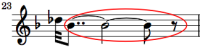
We also found an instance of this duration ratio, again formed with a rest, in Indian Summer by Victor Herbert, a song which though written in 1919 eventually became a jazz standard. Herbert uses a complicated formation employing a double dotted eighth note ties to a half note tied to another eighth note and finally followed by an eighth note rest. Calculation: 2 / (3.5 + 8 + 2) or 0.148.

The 0.148 duration ratio was used more than a dozen times again in the modern era. Our example was written in 1940 from the internationally well-known and popular song, Besame Mucho (Kiss Me Much), written and sung by Consuelo Velazquez. She also uses a double tie with no change in pitch to achieve the ratio, but it is possible to create it with a single tie. For instance, Passion Flower, a jazz standard from 1944, incorporates the 0.158 duration ratio with an eighth note tied to a whole note and followed by a quarter note triplet. Calculation: 2.67 / (2 + 8 + 8) or 0.148.
Intervals, plus or minus an octave, for duration ratio 0.148 found in the database (MIDI values):
-12, -10, -7, -5, -4, -3, -2, -1, unison, +1, +2, and +3.