In simple terms, “Chernoff faces” are a way to visualize big data. The concept was created by Herman Chernoff in an 1973 paper, “The Use of Faces to Represent Points in k- Dimensional Space Graphically,” J. Am. Stat. Assoc., v68, pp. 361-368 (1973). Chernoff used 18 facial features to create his faces to display large amounts of data, but his work is extensible. We have extended his work to display 22 variables using our melody metrics. Those already familiar with Chernoff faces can proceed directly to a detailed example in Chernoff Faces Explained.
The following figure is an example of a Chernoff face, annotated with the melodic metrics we used to draw the face. We used melodies from the film genre to draw this example:
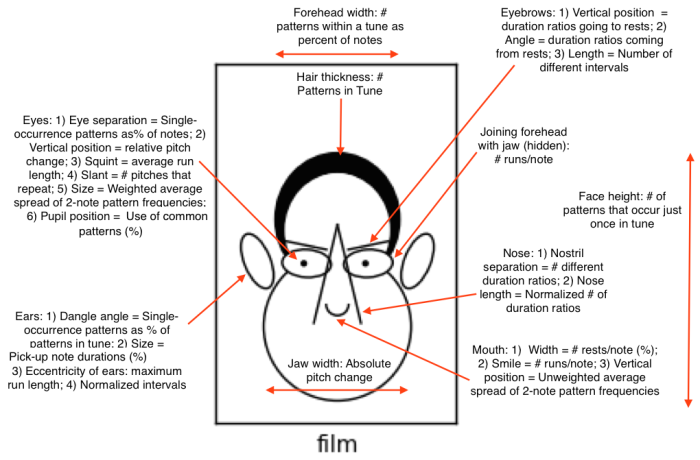
For a discussion of what Chernoff faces look like when drawn for the various musical genres in our database, go to the Chernoff Faces page. To be clear, the assignment of a specific metric to a specific Chernoff Face feature is somewhat arbitrary, but we were guided by the following principles:
[check_list]- Humans tend to focus on the eyes of a face, so we assign uncorrelated metrics to those features.
- We needed to limit the number of metrics to 24 for the Chernoff faces, which means that 8 metrics had to be dropped. We dropped those metrics that were somewhat redundant by finding those that were highly correlated (over 99.8% correlation coefficient). We retained some highly correlated metrics when doing so made the face look more “human.”
- Some facial features, such as the width of the forehead and the separation of the eyes, go together, so we use correlated metrics for such features.
Because we have a total of 32 metrics to describe our melodic data, we had to eliminate 8. Our 32 metrics are described fully on the metric page, but we repeat them in the following table as they apply to musical genres and the drawing of Chernoff Faces:
Chernoff Face Features Matched to Metrics
| Metric ID | Metric | Highly Correlated | Highly Uncorrelated | Facial Feature |
|---|---|---|---|---|
| 0 | Average Number of Patterns in Tune | #2, #18 | Hair Thickness | |
| 1 | Average Percent of Patterns Within a Tune | #4, #29 | #13 | Forehead Width |
| 2 | Average Number of Single-occurrence Patterns in Tune | #0, #18 | #15, #17 | Face Height |
| 3 | Average Percent of Single-occurrence Patterns as a Percent of Tune Patterns | #25, #31 | Ear Dangle Angle | |
| 4 | Average Percent of Single-occurrence Patterns As a Percent of Notes | #1, #29 | Eye Separation | |
| 5 | Average Number of Rests Per Note | #6 | Smile Width | |
| 6 | Absolute Pitch Change Average | #5 | Jaw Width | |
| 7 | Relative Pitch Change Average | Vertical Position of Eyes | ||
| 8 | Use of Common Patterns (Average Percent) | #15 | #27 | Location of Pupils |
| 9 | Average Percent of Tunes with Unique Patterns | #30 | Unused (Can’t be applied to single tunes) | |
| 10 | Average Range of Tunes | #14, #23 | Forehead Height | |
| 11 | Average Note Duration Ratio | Smile | ||
| 12 | Average # Runs Per Note | Joining Forehead with Jaw | ||
| 13 | Average Run Length | #1 | Eye Squint | |
| 14 | Average Maximum Run Length | #10, #23 | Eccentricity of Ears | |
| 15 | Average Number of Durations That Repeat | #8 | #2 | Unused (covered by #8) |
| 16 | Average Number of Pitches That Repeat | Eye Slant | ||
| 17 | Weighted Average Spread of Two-Note Pattern Frequencies | #2, #21 | Size of Eyes | |
| 18 | Unweighted Average Spread of Two-Note Pattern Frequencies | #0, #2, #31 | Vertical Position of Mouth | |
| 19 | Average Pick-up Duration | #20 | #23 | Unused (covered by #20) |
| 20 | Average Pick-up Percent | #19 | #24 | Ear Size |
| 21 | Average Duration Ratio Going to Rests | #17 | Vertical Position of Eyebrows | |
| 22 | Average Duration Ratio Coming from Rests | #29 | Angle of Eyebrows | |
| 23 | Average Number of Different Pitches | #10, #14, #24 | #13, #19 | Unused (covered by #24) |
| 24 | Average Number of Different Pitch Differentials | #23 | #20 | Length of Eyebrows |
| 25 | Average Number of Different Durations | #26, #31 | #3 | Unused (covered by #26 and #31) |
| 26 | Average Number of Different Duration Ratios | #25, #31 | Nostril Separation | |
| 27 | Average Normalized Number of Different Pitches | #28 | #8 | Unused (covered by #28) |
| 28 | Average Normalized Number of Pitch Differentials | #27 | Vertical Position of Ears | |
| 29 | Average Normalized Number of Durations | #1, #4, #30 | #22 | Unused (covered by #31) |
| 30 | Average Normalized Number of Duration Ratios | #29 | #9 | Nose Length |
| 31 | Average Percent of Tunes with the Same Individual Patterns | #18, #25, #26 | #3 | Unused (Can’t be applied to single tunes) |
| Correlations above 99.8% | Correlations under 2% | 23 of 32 metrics used to draw Chernoff Faces |