Chernoff Face Genres
This section selectively examines a few musical genres in terms of their Chernoff Faces. If you don’t know what a Chernoff Face is, start with Chernoff Faces–Introduction before proceeding here.
Scotch, English, Irish and Celtic
Figure 1, following, displays the Chernoff faces of folk songs from Scotland, England, Ireland, and from the entire Celtic region. We will observe a few similarities and differences and discuss whether they make sense with what we know about these folk tunes. Keep in mind that “Celtic” is made up of all the other three genres and therefore represents a kind of blend of Scotch, English, and Irish tunes.

Pupils. The pupils of each face are looking slightly to the viewer’s left. The location of the pupils is governed by the use of common patterns such that the more often common patterns are used, the more to the left the pupils appear in the eyes. Because folk tunes are largely made up of simple, common patterns of notes, it makes sense that all four of these faces have eyes looking to the left, especially when remembering that these genres represent quite early development of folk tunes.
Face Height. Once striking difference is that Scotch tunes have a much larger face than the other three. Face height is governed by metric #2, the average number of times a pattern occurs just once in a tune. In other words, Scotch tunes tend to be a bit more complicated relative to those in related genres in that they have fewer patterns that are used multiple times in a tune.
Smile Width and Jaw Width. Observe that both the smile width and the jaw width are slightly but noticeably larger for Irish tunes than the others. Smile width and jaw width are governed by metrics 5 and 6, respectively: The average number of rests per note and the average interval including rests. Irish tunes have slightly more rests than the others, and because the jump to rests is large when expressed as an interval (because a rest is valued as a zero MIDI value), their average interval is correspondingly larger.
Eye Size. We also see that the eyes for Scotch and Irish tunes are noticeably larger than those for Irish tunes. (Celtic tunes are a blend and fall in between.) Eye size is controlled by metric #17, the weighted average spread of 2-note pattern frequencies, measured by the standard deviation of how often 2-note patterns occur. This means that English tunes have a smaller variety of common and not-so-common 2-note patterns relative to Scotch and Irish tunes. The difference is small in terms of the raw values: Scotch and Irish tunes have values of 3.6 and 3.5, respectively, for metric #17, while English tunes have a value of 3.4. However, when normalized across all genres on a scale of 0-1, these values are 0.9 and 0.8 for Scotch and Irish tunes, respectively, and a value of 0.6 for English tunes. We also learn that in general Celtic tunes have larger eyes than the average genre, which means they all have a greater than average spread in the frequency of two-note patterns when compared to all genres of music in the database.
Ear Size. The ears on the English face appear larger than the ears on either that of Irish or Scotch, but all the ears are partially hidden by the size of the eyes on the faces. Ear size is governed by the pick-up notes at the beginning of tunes, metric #20, the average duration value of pick-up notes expressed as a percent of the duration value of the first measure. When we examine the raw values of this duration, we find 14 percent, 12 percent, and 18 percent for Scotch, English, and Irish, respectively. Because the maximum percent for any genre is 33 percent (for rhythm and blues), this difference is exaggerated on the face when the values are normalized to a scale of 0-1. So the Chernoff face for Irish tunes in fact has the largest ears, and therefore longer pick-up notes. This example illustrates again the importance of examining the Chernoff face carefully rather than accepting the initial impression.
Nose. The nose length on the Irish face is noticeably shorter than the noses on either the English or Scotch face. Nose length is drawn according to the number of duration ratios that have been normalized for the size of the tune (metric #30). Irish tunes have a smaller number of different duration ratios than do either of their English or Scotch counterparts. The raw metric #30 values for Scotch, English, and Irish tunes are, respectively, 8.8, 9.4, and 7.2. The raw values for metric #30 for all genres range from around 4 to 15, so these differences among Celtic tunes are noticeable on the Chernoff faces.
Eyebrows. The eyebrows on the Scotch face are clearly longer than those on the other faces. Eyebrow length is governed by metric #24, the average number of different intervals (changes in pitch). The respective values for eyebrows length are 12.9, 14.4, and 13.4 for Irish, Scotch, and English. This metric suggests that the Scotch use more intervals per tune than their counterparts in England and Ireland.
Renaissance, Baroque, Classical, Romantic
We next turn to the Chernoff faces of the four generally recognized musical eras: Renaissance, Baroque, Classical, and Romantic. We stop at “Romantic” because we are not far enough removed from the music that came afterwards to categorize it just yet. However, we will compare the Chernoff faces of more recent tunes later. Figure 2 displays the Chernoff faces of the four musical eras, and one immediately notices that they are all rather different, as might be expected given the span of centuries. Again, we will focus on a few noticeable similarities and differences.
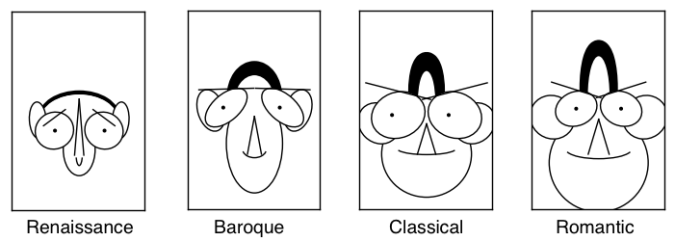
Face Size. It is perhaps immediately noticeable that the face size for the Renaissance tunes is considerably smaller than that for any of the other eras. Face height is governed by metric #2, the average number of times a pattern occurs exactly once in a tune. The values of this metric for the four eras, respectively, are 14, 19, 20, and 18. That is, Renaissance tunes have on average only 14 instances of 2-note patterns that occur one time in a given tune; that is, they tend to re-use patterns they do use. This observation is consistent with the relative simplicity of Renaissance melodies compared with the later eras.
Hair. The hair on the renaissance face is much thinner than that on any of the other era’s faces. Hair represents the average number of different patterns in a tune, consistent with the expectation that renaissance melodies are rather simple compared to those in later eras. The raw values for this metric are 29 for renaissance and 45, 52 and 48 for baroque, classical and romantic, respectively. While this is an obvious observation, the numbers quantify the difference, which is rather large.
Smile Width. The width of the smile gets progressively larger from the earlier to the later eras, though only slightly so as we move from classical to romantic. This facial feature represents the average number of rests per note. The rounded raw values are 1, 2, 5, 6 rests per note for renaissance, baroque, classical, and romantic, respectively. Over time, composers in these eras employed increasingly more rests to create different melodies. As an aside, this trend continued into the 20th century. Rock tunes, for instance, have an average of 8 rests per note.
Jaw Width. Like the smile, the jaw gets wider as we progress through the faces from the earliest era to the latest. Jaw width represents metric #6, the average interval where we include the intervals going to and from rests. As we’ve noted elsewhere, smile width is correlated with jaw width because the number of rests per note (smile width) is clearly correlated with this measure of intervals because both include rests. The raw values of metric #6 are 3, 6, 10, and 11, respectively. That is, the average interval including rests for renaissance tunes averages a minor third, while romantic music averages a major seventh.
Forehead Height. The height of the foreheads also increases in size as we move through the musical eras chronologically. Forehead height is governed by metric #10, the average range of the melodies. As would be expected, the average range increases as time progresses. The raw values of metric #10 for the chronological order of the faces are 14, 21, 22, and 27, respectively. Observe that there is quite a large jump from the renaissance to the baroque, and again from the classical to the romantic. The change in eras from the baroque to the classical did not involve nearly such a large increase in the average range of melodies.
Ears. The ears progress from being thin and pointy on the renaissance face to round and fat on the romantic face. The roundness of the ear is controlled by average maximum run length in the genres: the rounder the ears, the longer the average maximum run length. This means that composers of renaissance tunes did not employ many long runs, while those in the romantic era did use at least one long run. The raw values for the average maximum run length in the renaissance, baroque, classical, and romantic eras are 5, 6, 7.6, and 8, respectively. The maximum run length in romantic melodies, therefore, exceeded that of renaissance melodies by an average of three. As an aside, the genre with the highest average maximum run length is ballet, many of which were written during the romantic era in the database.
Eyebrow Angle. The angle of the eyebrows from the horizontal represents average duration ratio when the first note is a rest and the second note is a played pitch. The metric is calculated so that small duration ratio genres have eyebrows drawn at a downward angle from the center of the face, and large duration ratio genres have eyebrows drawn at an upward (V-shaped) angle from the center of the face. The four faces in Figure 2 exhibit generally increasing values of this metric from renaissance through romantic. The raw values are 0.2, 0.5, 0.8, 0.96, respectively in increasing order of the eras. In other words, renaissance tunes have quite small average duration ratios coming from rests (eyebrows slant down from the center). Baroque tunes more than double the size of the duration ratio, and the duration ratio coming from rests increases substantially more for the classical era. The romantic era experiences a smaller increase. We can conclude that in general composers used increasingly longer durations for their second notes relative to the preceding rest over the time span of these four musical eras.
Nose. The length of the nose on the renaissance face is strikingly longer than those on the other faces. Nose length represents the average number of duration ratios normalized by dividing by the number of notes in each tune. The raw values for this metric are 11, 7, 5, and 7, respectively, for renaissance, baroque, classical, and romantic. It may seem surprising that this metric would be large for simple renaissance tunes, but the finding can be explained by examining the non-normalized average number of duration ratios: 8, 10, 11, and 12. Because renaissance tunes are short when compared to tunes in the other three eras, the smaller denominator (number of notes) creates a larger relatively value for renaissance tunes when normalizing the average number of duration ratios. Nostril separation represents the non-normalized average number of duration ratios, and consistent with the values just shown the nostril separation of the nose on the renaissance face is smaller than that on the other three faces.
Christmas Carols and Secular Christmas Songs
Over the centuries the celebration of Christmas expanded from a religious holiday to include secular celebrations. The music and songs associated with Christmas followed suit. We classified Christmas songs as either religious or secular, creating a separate genre for each in our database. Religious Christmas tunes we classified as “carols,” even though the word “carol” is used more generally to designate any song of joy celebrating any religious holiday in any religion. We classify a song as a carol if it overtly mentions a religious theme relating to Jesus Christ’s birth or any of the biblical stories deriving from the nativity story. We classify a Christmas song as “Xmas” if it does not refer to such a religious them and instead refers to secular aspects of Christmas, such as Frosty the Snowman or bells that jingle. Figure 3 illustrates the two Chernoff faces for carols and xmas tunes.
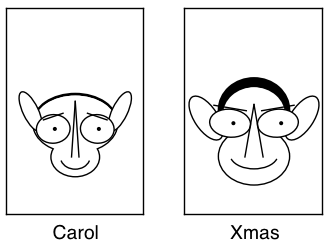
We can immediately see some similarities in the two faces. The face is roughly the same size, which means that the average number of times a 2-note pattern occurs just once in a tune is about the same for each genre. Likewise, the eyes are about the same size, so the weighted average spread of the frequencies of 2-note patterns (their spread) is nearly the same for each. The angle of the ears is similar, and that means the average percent (of the total number of tune patterns) of 2-note patterns that occur just once has similar values for each genre. The eyes are looking slightly to the viewer’s right, indicating that both use common patterns about the same amount (because the eyes are looking right, more common patterns are used on average for these two genres than for the other genres). Finally, the nose lengths are not too far apart, so the average normalized number of duration ratios is also not too far apart for the two genres.
Differences Between the Carol Genre and the Xmas Genre
There are many differences, such as hair thickness, smile width, and the eyebrows. Before we examine those differences, let’s think about the relationship each of these genres might have with other genres, setting aside the fact that carols and Xmas music are both themed to a widely celebrated holiday that crosses religious lines into popular culture. Christmas carols are are largely a subset of hymns, as most, if not all, carols are also sung in Christian churches at Christmas time. Likewise, Xmas tunes are often popular tunes covered by many artists and might therefore be related to the pop genre. Figure 4 displays the four genres side by side: Hymns, carols, Xmas, and pop.
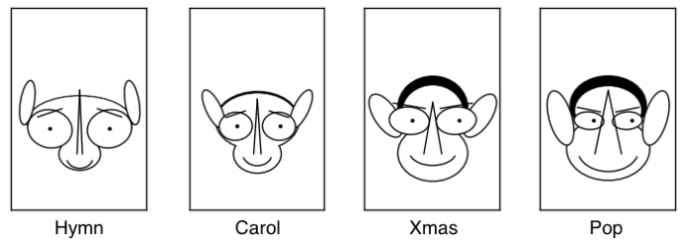
Comparing the faces, one can immediately see the similarities between the hymns and carols, and those between Xmas tunes and pop songs. In fact, one could argue that the faces of hymns and carols are more similar to each other, and Xmas tunes and pop songs are more similar to each other, than carols are to Xmas tunes. It will be instructive to examine some of the facial features of all four faces to draw out the relationships among these four musical genres.
Hair. Hymns are similar to carols in that both have thin hairlines because both have fewer patterns than the Xmas and pop genres. The raw values for the number of different 2-note patterns in hymns and carols are 24 and 27, respectively, while they are 38 and 40 for Xmas and pop, respectively. Carols are more similar to hymns than xmas songs in this regard, and Xmas songs are more similar to pop songs than carols.
Smile Width. The width of the smile on hymns and carols is narrower than the width of the smile of either the Xmas or pop faces. Smile width represents the average number of rests per note. The raw values for the four genres are 2.4, 2.6, 4.1, and 5.3, respectively, left to right in Figure 4. That is, Xmas and pop songs both have substantially more rests per note than hymns and carols do.
Jaw Width. As we noted elsewhere, we assigned metrics so that the metric representing jaw width is correlated with that representing the width of the smile in order to assure that the smile is contained in the face. Metric #6, the average interval when rests are included, represents jaw width and has the values 3.8, 4.5, 7.1, and 8.6 for hymns, carols, Xmas songs, and pop songs, respectively. The more rests there are in a tune (representing smile width), in general, the higher we can expect the average interval. Thus it is not surprising that the pattern for jaw width is consistent with that for smile width: hymns and carols have a much lower average interval than do songs in the Xmas and pop genres.
Nostril Separation. The nostrils, which represent average number of different duration ratios, are far more separated for Xmas and pop tunes than for either hymns or Christmas carols. Both hymns and carols are older genres, whereas Xmas and pop songs tend to be more recent. As documented elsewhere, composers keep adding new duration ratios over time, so it makes sense that both hymns and carols would have fewer than the Xmas or pop songs of the 19th century. The raw values of this metric are 7, 7, 11, and 14, respectively for hymns, carols, xmas and pop songs.
Forehead Width. One striking surprise is that the face representing hymns has a much wider forehead than any of the other three genres. Forehead width represents the number of 2-note patterns as a percent of the number of notes in a tune. The raw values for hymns, carols, Xmas and pop songs are 45, 39, 34, and 35, respectively. In fact, hymns have the highest value for this metric among all major genres in the database. Hymns tend to be easily singable, simple melodies of minimal length When the small number of notes are divided into the number of 2-note patterns, a large number emerges. Carols, though also hymns, tend to be a bit longer than most hymns: Hymns average only 57 notes each, whereas carols average 88 notes each.
Ear Dangle. Oddly, the angle of the ears on the ‘carol’ face is more similar to those on the faces of both the Xmas and pop songs than on those of the ‘hymn’ face. The anomaly can be explained again by the relative length of the tunes. Ear dangle represents the average number of 2-note patterns that occur exactly one time in a tune as a percent of all the 2-note patterns in the tune: the higher the percent, the more one-time patterns there are, corresponding to ears that are angled inward. Indeed, hymns have among the highest values of this metric at 50 percent. Carols, Xmas and pop songs have values of 43, 41, and 45 percent, respectively. As with forehead width, the high percent for hymns is largely because hymns are generally short melodies, resulting in higher percents when a metric is normalized by the number of notes or number of patterns.
Ear Thickness. The ears on both Xmas and pop songs are thicker than those on the faces of hymns and carols. Ear thickness represents the average maximum run length such that the thicker the ears, the longer the average run length. The values for this metric are 4.5, 4.7, 5.3, and 5.0, respectively, for hymns, carols, Xmas and pop songs, which is consistent with what we see in the faces. Maximum run length is another metric that illustrates more similarity between hymns with carols, and Xmas tunes with pop songs, than with carols and Xmas tunes.
Eyebrows. The eyebrows angle downward from the center on the hymn and carol Chernoff faces, and angle upward on the Xmas and pop faces. Eyebrow dangle is determined by the average duration ratio when a rest is followed by a note. Downward angles indicate a low duration ratio average and upward angles indicate a high one. The raw values for this metric are 0.4, 0.4, 0.7, and 0.8 for hymns, carols, Xmas and pop songs, respectively. Xmas and pop songs, therefore, have longer rests relative to their preceding note than do hymns and carols. This finding makes sense when you remember that most Xmas and pop songs are 20th century when composers started experimenting with tying notes together in unusual ways to produce new 2-note patterns. Hymns and carols, on the other hand, are often older tunes that use relatively simple patterns.