Musical Genre Differences with Metrics–Introduction
Most people can differentiate two styles of music, such as Irish folk tunes and jazz, quite easily and almost immediately. Traditional musicologists explain that difference descriptively in words. Quantifying that difference started in the 1950s with the advent of mainframe computers, but has recently entered a new phase with both more powerful personal computers and machine-learning, including AI. The Skiptune project is properly placed in the newest phase, which includes metrics. These metrics are described here on the website. We explore two ways of comparing musical genres. The first is through simple correlations, and the second is through a visual representation.
To introduce the idea of comparing different musical genres with our metrics, we choose two well known and easily understood genres, nursery songs and operatic tunes. Everyone has an intuitive understanding of each of these musical genres, and that will allow us to get quickly to the analysis. Later we compare many other musical genres that are more difficult to define.
Nursery Songs and Operatic Tunes
We define the various musical genres we use here, but in a nutshell nursery songs are any that have been purposely written for children, that children make up and sing on their own, or which children take from songs that were first popular with adults. Operatic tunes, such as arias, are any written for or appearing in an opera. Both genres have been around a long time and are commonly understood. No one would mistake a nursery rhyme for an operatic aria, so these two genres are a good place to start our analysis of differences. As with all of the tunes used in our analysis, all have survived at least 50 years after their first publication.
One point of clarification: The styles of opera singing and nursery song singing are also quite different from each other. Opera voices are heavily trained and exhibit a strong vibrato (the periodic and pleasing variation in pitch around the main note), while most of us associate nursery songs with children’s untrained voices. We examine no such style differences here, focusing instead entirely on the melodic line.
Finally, this analysis was conducted in January 2020 with 48,000 melodies in the database. Roughly 1,700 nursery melodies were represented and about 1,400 operatic melodies.
Range
We first examine the average range of the two genres. We would expect nursery rhymes to have a much smaller range than operatic tunes because children have much small vocal ranges than professional opera singers. That is indeed the case as the average range of nursery songs in our database is about an octave (12 MIDI values), while the average range of operatic tunes is well over an octave (15 MIDI values).
Uniqueness
Being simple, nursery tunes should have fewer unique patterns than operatic tunes, and that is indeed the case. Nursery tunes have almost no unique patterns (0.3 percent of them, or five tunes), while 2.1 percent of the operatic tunes have at least one unique two-note pattern (30 melodies). Another measure of uniqueness is a metric representing the commonness of two-note patterns. Using this metric, nursery songs have a metric of 3.5 percent while operatic tunes are at 3.0 percent. Higher numbers represent more common patterns, so nursery tunes use more commonly-used patterns than operatic tunes. While this difference may seem small, it is statistically significant.
Intervals
We would expect operas to contain tunes that have larger intervals on average than children’s songs, and this is indeed the case. The average pitch change in MIDI values for operatic music is 11 when rests are included, but only 7 for nursery tunes. These values include the effect of rests, which add greatly to the average because jumps to and from rests are the difference between a MIDI value, such as 60, and zero. When we remove the effect of rests, the operatic and nursery average intervals are only 2.4 and 2.1, respectively. While these values seems much closer (between a major second and a minor third), it is still a significant difference because of their tight distributions. By either measure, operatic music contains larger jumps in pitch than nursery rhymes, which is completely intuitive.
Number of Pitches, Intervals
The simplicity of nursery rhymes would suggest that the palette of note patterns used by composers would be less rich than the palette used for operatic songs. This is indeed the case. The average nursery rhyme is composed 8 different pitches, whereas operative pieces have on average 11 different pitches. In other words, operatic tunes use on average three more different pitches than children’s tunes. Likewise, one would expect nursery songs to have a fewer number of different intervals than operatic tunes, and the data says that nursery tunes have on average 9 different intervals, whereas operatic tunes have around 11 different intervals.
But those metrics ignore the length of the melody in question. When we normalize the data for the length of the tune, remembering that nursery rhymes tend to be quite short compared to operatic tunes, the numbers retain the same order but are much closer. Nursery tunes have 0.22 different pitches per note and operatic tunes have 0.24 different pitches per note, consistent with the above finding. But for intervals, nursery and operatic tunes have 0.25 and 0.24 different intervals per note, suggesting that on this measure, nursery and operatic tunes are similar, with nursery tunes have a slight edge.
Durations
Likewise, we would expect nursery rhymes to have simpler sets of durations. The evidence bears this out as nursery tunes have on average around 4 different duration values represented in the notes, whereas operatic tunes have about 6. If we examine the duration ratios (in contrast to just the durations themselves), we discover a similar pattern: Nursery tunes employ about 6 different duration ratios, while operatic tunes use 8 on average.
However, nursery tunes are generally quite short compared to operatic songs, so we need to normalize the metrics by dividing by the number of notes in each tune. When we do so, nursery tunes still have fewer numbers of different durations and duration ratios. Nursery tunes have 0.12 different duration values when the number of notes are accounted for, and operatic tunes have 0.13. Likewise, there are on average 0.16 different duration ratios when normalized for nursery tunes, and 0.18 for operatic tunes.
Correlations
We are not going to go into detail on how statistical correlations work, but as a reminder, a correlation analysis results in a coefficient that measures the extent to which one set of data moves with another set of data. The correlation coefficient can range from negative one to one (-1 to +1), where “zero” indicates no relationship or correlation, and “one” indicates a perfect relationship, and a “negative one” or -1 indicates the two variables move opposite to each other. At the risk of oversimplifying, a correlation of “one” means that the two things being examined move in the same direction.
When we calculate the correlation coefficient of genres based on our music metrics, we mostly get numbers above 0.9 and none are below 0.7. This range means that our genres are highly correlated with each other. It is not surprising that the musical genres are highly correlated with each other because they are all tunes that have stood the test of time with us humans. If we entered a bunch of random notes and calculated their metrics, we’d find them uncorrelated and even negatively correlated with our music. Humankind has produced a highly organized and consistent set of melodies over its existence.
By examining only pairs of musical genres with extremely high correlations, say above 0.998, we can test whether or not the results are consistent with what we know about the musical genres a priori.
Highly Correlated Genres
Each of the following pairs of musical genres exhibit a correlation with each other of at least 99.8 percent:
[check_list]- Film and TV
- Pop and TV
- Pop and Film
- Dance tunes and Scotch tunes
- Hymns and American tunes
- Ballads and German tunes
- Rennaisance tunes and English tunes
- Baroque tunes and Duet tunes
Each of these musical genres are related to each other, either musically or because of the nature of our data entry thus far. Film and TV tunes are similar in that both are popular media for entertainment, and one influences the other. In addition, songs popular on TV are often popular on film as well. The same observation explains the high correlation between pop music and TV, and pop music and film.
It’s not clear why dance tunes, a genre that encompasses every type of dance known, would be highly correlated with Scottish tunes. The Scotch don’t have a monopoly on dance music, so it can’t be that most of the tunes designated as both “dance” and “Scotch” explain this high correlation. This question will be one we take up after entering more melodies to see if the correlation holds up. Likewise for hymns and American tunes, both are broad categories that don’t necessary overlap too much. The same puzzlement applies to ballads and german tunes, though we suspect that having entered all of Shubert’s ballads, the database may be weighted too far in the direction of German ballads. This bias will disappear as we enter more tunes.
The high correlation between Rennaisance and English tunes may be explained by the overlap of the two genres: A lot of renaissance music came from England. Likewise, a lot of the duets we have in the database were written during the baroque period, so that explains the high correlation between the two genres.
Relatively Low Correlations Among Genres
Here we examine those genres that are not as highly correlated with each other. We emphasize that calling them “low” correlations is true only relatively speaking. Normally, a correlation of 0.7 or h higher is considered correlated. The following genres all have correlations between 0.7 and 0.8:
[check_list]- Reels and pop tunes
- Jigs and rock tunes
- Reels and TV tunes
- Reels and German tunes
- Reels and film tunes
- Reels and Ballads
- Reels and rock tunes
This list is striking for the fact that all but one paring involves reels, and the other involves jigs that are similar to reels. Both jigs and reels are dance tunes and both arose out of the Celtic culture. In terms of meter, reels are in 4/4 (or 2/2) time, while jigs are in 6/8 (or 9/8 or 12/8) time. What they have in common is a liveliness and a propensity to use lots of eighth notes.
Most of the reels and jigs in the database are hundreds of years old, and perhaps their age explains why they are not so highly correlated with the more modern musical genres of pop, rock, TV, and film. It is also somewhat obvious why ballads are not highly correlated with reels as ballads are neither known for being lively nor being danced to, and have a much richer variety of notes other than eighth notes forming them. Many of the German songs we have entered are also ballads, so perhaps that explains the low correlation between reels and German tunes.
Plot of Highly Correlated and Not-So-Highly Correlated Genres
Figure 1 displays a scattergram plot of the two most highly correlated genres, pop tunes and TV tunes, and the least correlated genres, reels and rock tunes.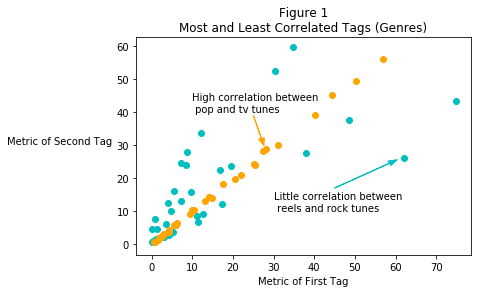
The orange dots plot the highly correlated genres of pop and TV tunes, while the blue dots plot the not-so-highly correlated genres of reels and rock tunes. Observe that the orange dots almost form a straight line along the diagonal of the plot area. This is the plot of an almost perfectly correlated set of data. Now examine the blue dots and see that while they are somewhat clustered together near the lower left of the plot area, they diverge widely as they move to the right and upwards. The reels and rock tunes in blue are still correlated because as one moves to higher metric values, so does the other, but they do not move in lockstep as do the pop and TV tunes in orange.
Chernoff Faces
In this introduction to the exploration of musical genre differences, we used language to describe just a few differences. Rather than continuing with that approach, we are going to turn to Chernoff Faces to graphically represent the genre differences. We continue the exploration of the differences and similarities between musical genres with Chernoff faces here.