2-note pattern — Two consecutive melodic notes in a tune (see Pattern).
Adagio — To play in a slow tempo.
Allemande — A musical form invented during the renaissance (1500s) and evolving into a popular dance during the baroque era (1600s).
Atonal — Music written without a tonic. In general this term refers to music which does not necessarily resolve at the end.
Augmented fourth (abbr. aug4 or aug 4th — An interval between two notes with a MIDI value of 6. For example, an augmented fourth up from “G” is “C#” or “Db”.
Ballad Opera — A form of musical theatre popular in the middle 1700s in England with singing, dancing, minimal or no plot, and often comic or sentimental.
Bar — A segment of notes which must contain a specific number of beats, each of which is assigned a particular pitch value. “Bar” and “measure” are used interchangeably.
Baroque era — The musical era, roughly speaking, from 1600 to 1750.
Bransle — A simple circle dance, usually with alternating men and women, from the renaissance era.
Bridge — A short musical phrase that contrasts with what came before while preparing the listener for a return to earlier material such as a verse and chorus.
Bunting, Edward — A trained Irish musician who, at a young age, was commissioned to collect all known Irish folks tunes in 1793 from gathered harpists and other Irish musicians. His subsequent publication, Ancient Music of Ireland, in three volumes provides a rare glimpse of Ireland’s ancient tunes. There are precious few such collections in other cultures.
Cadenza — A virtuoso solo section of music inserted into a larger musical piece, played by a single instrument; all other instruments that may be present are silent while the cadenza is being played.
Chaconne — A musical form and sometimes dance from the late renaissance and baroque periods.
Chernoff Faces — A visual, graphic method to represent big data. We use it to represent the differences between musical genres.
Classical era — The musical era, roughly speaking, from 1750 through the early part of the 1800s.
Correlation and Correlation Coefficient — A statistical concept that measures on a scale of -1 to +1 how well two or more things are related, connected, depend on one another, or move together. A correlation coefficient of zero indicates they are independent of each other. A correlation coefficient of “one” means they are completely dependent on each other. A correlation coefficient of “negative one” indicates they move in opposite directions. Colloquially, “correlation” and “correlation coefficient” are often used interchangeably.
Courante — A 16th-century court dance in which the partners approach and retreat from each other.
Cut Time — A time signature in 2/2, where the half note gets the beat and there are 2 half notes worth of beats in a measure; often used when a musical piece would be difficult to conduct in 4/4 time because doing so would be physically demanding because of the speed.
Duration or Duration Value— How long a note is sustained. We assign a quarter note a somewhat arbitrary duration of 4 and scale all other notes from there proportionately. Note durations have the following values:
- – Whole note = 16
- – Half note = 8
- – Quarter note = 4
- – Eighth note = 2
- – Sixteenth note = 1
- – Thirty-second note = 0.5
- – Sixty-fourth note = 0.25
- – One-hundred and twenty-eighth note = 0.125
- – A dotted note adds one half of the previous duration value. For instance, a dotted quarter note = 6. A double-dotted quarter note = 7.
Duration ratio — In a pair of consecutive notes, the duration of the second note divided by the duration of the first note. If both notes are quarter notes, the duration ratio is 1 (4/4 = 1).
Fifth (abbr. 5th) — An interval between two notes equal to a MIDI difference of 7. For example, a fifth up from a “G” is a “D”.
Fourth (abbr. 4th) — An interval between two notes equal to a MIDI difference of 5. For example, a fourth up from a “G” is a “C”.
Frequency–The number of times something occurs. This use of the word ‘frequency’ is distinguished here from its usual use in music analysis to refer to the number of vibrations that occur per second to produce a given pitch. Unless we note otherwise, all uses of ‘frequency’ on this site refer to how often something occurs in a tune or musical genre, usually a two-note pattern.
Galliard — A vigorous and choreographed dance in triple time for two people, including athletic turns, steps, and leaps; arose during the renaissance period.
Genre — Recognizably different styles of music. Examples of genres include country western, baroque, rock, operatic, romantic, jazz, irish, american, and showtunes.
Giga — See gigue and jig. The jig (English), gigue (French), and giga (Italian) are baroque dances that are usually written in time signatures of 3/8, 6/8, 6/4, 9/8, or 12/8.
Gigue — See giga and jig. The jig (English), gigue (French), and giga (Italian) are baroque dances that are usually written in time signatures of 3/8, 6/8, 6/4, 9/8, or 12/8.
Ground — A repeated bass pattern above which are variations on a theme or melody, popular in the renaissance and baroque eras in Europe.
Habanera — A slow Cuban dance with a tango-like rhythm.
Half step — See “interval.” An interval of two; also known as a half tone or semitone.
Half tone — See “interval.” An interval of two; also known as a half step or semitone.
Impressionistic — in music, a style during the late 19th and early 20th centuries in which the overall affect of the piece conveys a desired ambience or atmosphere, focusing more on an emotional than a cerebral response.
Interval (aka Pitch Change) — In a pair of notes, the MIDI value of the first note subtracted form the MIDI value of the second note. An interval of one is a semitone, half step, or half tone. An interval of two is a tone, a whole tone, or a whole step.
Jig — See giga and gigue. The jig (English), gigue (French), and giga (Italian) are baroque dances that are usually written in time signatures of 3/8, 6/8, 6/4, 9/8, or 12/8.
Key — Refers to the scale a tune is written in. In the Skiptune database, all tunes are classified as written in either a major or minor key, even tunes written in modes, for ease of data entry. See “major key” and “minor key.”
Lentement–A French word meaning slow, used in music to indicate a piece that is to be played slowly, 40 to 60 beats per minute.
Law of Large Numbers — This principle of statistics says that as a sample of data grows in size, its mean will tend toward the average of the entire population (all the data, including that which is not in the database yet).
Major key or major scale — An 8-note series of notes with intervals 2, 2, 1, 2, 2, 2, 1. An example is the scale in C major: C-D-E-F-G-A-B-C.
Major second (abbr. M2 or major 2nd) — An interval between two notes with a MIDI value of 2, or two steps. For example, a major second up from “G” is “A”.
Major seventh (abbr. M7 or major 7th) — An interval between two notes with a MIDI value of 11. For example, a major seventh up from “G” is “F# or “Gb”.
Major sixth (abbr. M6 or major 6th) — An interval between two notes with a MIDI value of 9. For example, a major sixth up from “G” is “E”.
Major third (abbr. M3 or major 3rd) — An interval between two notes with a MIDI value of 4. For example, a major third up from “G” is “B”.
Mean — Statistical term meaning the simple average of a set of data.
Measure — A segment of notes which must contain a specific number of beats, each of which is assigned a particular pitch value. “Bar” and “measure” are used interchangeably.
Median — Statistical term meaning the data point that has half of the other data points below it and half above it.
MIDI — Musical Instrument Digital Interface is an open technical standard that describes a protocol for transferring music. Skiptune only uses the pitch numbering system from the MIDI standard. In this system, middle “C” has the value 60, and each half-tone is worth 1. Thus the “D” above middle “C” is 62, and the “B” below middle “C” is 59.
Minor key or minor scale — An 8-note series of notes with intervals 2, 1, 2, 2, 1, 2, 2. An example is the scale in A minor: A-B-C-D-E-F-G-A.
Minor second (abbr. m2 or minor 2nd) — An interval between two notes with a MIDI value of 1, or one step. For example, a minor second up from “G” is “G#” or “Ab”.
Minor seventh (abbr. m7 or minor 7th) — An interval between two notes with a MIDI value of 10. For example, a minor seventh up from “G” is “F”.
Minor sixth (abbr. m6 or minor 6th) — An interval between two notes with a MIDI value of 8. For example, a minor sixth up from “G” is “D#” or “Eb”.
Minor third (abbr. m3 or minor 3rd) — An interval between two notes with a MIDI value of 3. For example, a minor third up from “G” is “Bb”.
Mode (statistics) — Statistical term meaning the value that appears most often in a set of data.
Mode (musical) — In music, used to describe particular scales that do not fall within Western musical definitions of a regular key.
Normalize — A statistical term that simply means to take into account how large something is, usually accomplished by dividing by the number of items in a group. For our purposes, this almost always means dividing a metric by the number of notes in the tune. Doing so allows us to compare long tunes with short ones on a fair, or “normalized,” basis. Note that “normalize,” the verb, means something quite different from the noun forms (“normal,” “normality”) and the adverb form (“normally”) in that “normalize” does not refer to the bell curve and means something quite different.
Normally Distributed — AKA normal distribution, distributed normally, or just normal. The bell curve distribution that has the following features:
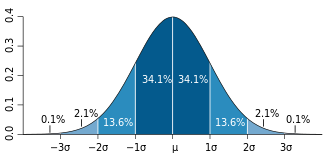
- 1. Symmetric around the middle (the mean average)
- 2. The mean, median, and mode are all equal
- 3. The area under the bell curve is equal to 1.0
- 4. The distribution can be completely described by its mean (µ — the Greek letter “mu,” pronounced “myou”) and the standard deviation (σ — the Greek letter sigma).
- 5. Roughly 2/3 of the area under a normal distribution lies between one standard deviation on either side of the bell curve, and roughly 95 percent of the area lies between two standard deviations on either side of the bell curve.
Note Duration — How long a note is sustained (see “Duration”).
Octave — Two notes in which one is twice the frequency of the other; notes that are an octave apart have the same letter designation, such as a “C” note (all “C” notes are an octave or multiples of an octave apart from each other). The MIDI value of two notes an octave apart is 12.
O’Neill, Capt. Francis — An Irishman who transplanted to America, became a cop to pay the bills, and collected Irish music as his avocation. One of his publications alone, O’Neill’s Music of Ireland (1903), contains 1,850 tunes.
Pattern — Any series of notes. The simplest pattern is a series of two consecutive notes, known as a 2-pattern. A 2-pattern is represented by two numbers in square brackets. The first number is the duration ratio, the value of the second note’s MIDI value less the first note’s MIDI value. The second number is the pitch change, the ratio of the second note’s duration divided by the first note’s duration. A middle “C” quarter note followed by another middle “C” quarter note is therefore represented by [0,1] because there’s zero difference is the pitch between the first and second notes (60 – 60 = 0), and the durations are the same (4/4 = 1).
Pavane — A stately dance arising in the late renaissance period with continue popularity during the baroque era.
Perfect fifth — An historical term that means the same as a “fifth.”
Pitch change (aka Interval) — In a pair of notes, the MIDI value of the first note subtracted form the MIDI value of the second note. If the pair of notes consists of a middle C note followed by the D above it, the pitch change is 2 (62 – 60 = 2). Also known as an interval.
Pitch differentials — See Pitch Changes.
Polonaise — Dance music originating in Poland, stately in tempo (3/4 time) and often used for processions; many measures begin with an eighth note followed by two sixteenth notes.
Reciprocal — The result of swapping the numerator for the denominator in a fraction. For instance, the reciprocal of 1/2 is 2/1 or simply 2. Thus, 0.5 is the reciprocal of 2.
Renaissance era — The musical era, roughly speaking, from 1400 to 1600.
Resolve — To come back to the tonic at the end of a musical piece. Music that resolves “feels” as though it has concluded and has gone from consonance to dissonance back to consonance.
Romantic era — The musical era, roughly speaking, from the early 1800s to the early 1900s.
Run — A series of notes whose pitches move in one direction either up or down a scale.
Run length — The number of notes in a run.

Scotch snap — A short note followed by a longer note with the short note on the downbeat, found often in Scotch tunes and less commonly in other musical genres. A common use is a sixteenth note followed by a dotted eighth note.
Semitone — An interval of one; also known as a half step or half tone.
Skiptune database — The digital storage of the melodic lines of tunes, songs, or pieces of music with melodic lines. The tunes must have stood the test of time (being played in some fashion at least two generations, or 50 years, after being written. The tunes must also have been written in standard Western musical notation. No tunes written after 1965 are yet in the database, although these will be entered one year at a time with each passing year.
Snap — (See “Scotch snap”)
Staff — The five horizontal lines on which notes are placed to indicate a melody; the plural of “staff” is “staves.”
Standard deviation — A statistical metric indicating the amount of variation from the average. Data with a small standard deviation is concentrated narrowly around the average; data with a large standard deviation is spread out widely around the average. The formula for calculating the standard deviation of a sample is in equations.
Statistically Significant — A statistical term of art that allows one to test the validity of an hypothesis. In the context of this website, the term is usually used either to test whether a group of data is normally distributed or whether two sets of sample data could have come from the same population. Unless otherwise specified, we use a 5 percent testing level.
Staves — See “staff.”
Tag — A word or short phrase attached as meta-data to a tune in the Skiptune database. “Genre” is a kind of tag, but other tags include the composer of the tune, the key it was written in, the year in which the tune was written, the key signature, and the tempo in beats per minute.
Tin Pan Alley — term used to describe the type of American songs surging in popularity during the late 1800s and early 1900s, centered in Manhattan.
Tonal — Music that has a tonic. Music written prior to the 20th century is virtually all tonal. Music written after the 20th century is mostly tonal, but atonal music is also written. Tonal music resolves at the end.
Tonic — The pitch which establishes the key or scale in a musical piece. The tonic of a tune in the key of G is a G; the tonic of a tune in A minor is A. The tonic is also the note on which most music resolves at the end of the piece.
Tuplet — A collection of any set of notes that multiplies the duration value of each note by the same factor to create a different number of duration values. The most common example of a tuplet is the triplet, which consists of three notes whose duration value has been altered by a constant multiplier. Tupelos are signified in musical notation by a horizontal bracket that encompasses the notes in the tuplet, along with the number of notes written under (or over) the bracket.
Triplet — Squeezing the duration value of three notes into a duration normally taken by two notes. For instance, the duration of a triplet quarter note is 2/3 the duration of a quarter note.
Unison or unison interval — Two consecutive notes of the same pitch (MIDI value of the two pitches are the same, so the interval is zero).
Unique pattern — A consecutive series of notes that only occur in one tune in the database. This term refers to 2-note patterns unless specifically noted otherwise.
Whole step or whole tone — See “interval.” An interval of two; also known as a tone.