This page documents two-note patterns that are somewhat surprisingly rare. Elsewhere we define somewhat surprisingly rare patterns as those occurring from just 30 times in the Skiptune database to 99 times and meeting other criteria. For each pattern we show:
⇒ The duration ratio in integer form as a fraction
⇒ The number of tunes in which the duration ratio was found in the database, including those involving rests
⇒ The chronological first instance of a duration that we can find in our database, but avoid those involving rests unless they are interesting.
⇒ The fractional form of the duration ratio and a verbal description of the notes needed to form that duration ratio
⇒ Examples of tunes from each century in which we have an instance of this duration ratio’s use. Each instance ends with how the duration ratio is calculated with the notes shown.
⇒ A list of intervals, within an octave around unison, that have been used to date with this duration ratio
Example S1: 0.273 Duration Ratio, 72 tunes
How Formed: 3/11 ratio, such as a whole note tied to a dotted quarter note and followed by a dotted quarter note.

The first use of the 0.273 duration ratio was by Chopin in his Nocturne No. 9, Op. 1, written in 1831. Chopin’s formation was somewhat tortuous, a quarter note followed by an eighth note in an 11-note tuplet. We do find that the vast majority of instances of this duration ratio involve a tuplet of some kind, usually a triplet. Chopin’s pitch differential is a full octave upwards (MIDI value of +12). If this were the only way to form a 0.273 duration ratio, we would expect to see very few, but as the next cite shows, there are simpler ways than the one Chopin employs. Calculation: (6/11 x 2) / 4 or 0.273.
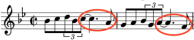
This duration ratio was not used again until the 20th century where we have over 20 instances of its use. Our cite is from the Italian song, Non Dimenticar (Don’t Forget) from Anna, a 1951 Italian film that gained some international recognition. Interestingly, this rare duration ratio is used by the composer, P.G. Redi, twice in the first two measures of the song, first with a pitch difference of a downward minor third, and then a downward major third (MIDI values of -3 and -4, respectively). Redi forms the duration ratio with a triplet eighth note tied to a dotted quarter note and followed by an eighth note. Calculation: 2 / (1.333 + 6) = 0.273.
Intervals plus or minus an octave for duration ratio 0.273 found in the database (MIDI values):
-9, -7, -5, -4, -3, -2, -1, unison, +1, +2, +3, and +12.
Example S2: 0.889 Duration Ratio, 67 tunes
How Formed: 8/9 ratio, such as a whole note tied to an eighth note and followed by a whole note.

The first time we encounter the 0.889 duration ratio in the database is in the year 1649. Froberger wrote a Toccata with a 32nd note followed by a 32nd note in a tuplet where nine 32nd notes are squeezed into the time normally allotted for eight. This piece also contains a rarely seen 0.563 duration ratio (see extremely rarely used). Calculation: (0.5 x 8/9) / 0.5.

We find the 0.889 duration ratio a few decades later in 1720 in the allegro section of J.B. Loeillet de Gant’s Sonata for Two Flutes, Op. 5, No. 5, but that instance employs a rest and is not shown here. The next non-rest instance occurred in 1847 by Chopin in one of his waltzes (Waltz from Three Waltzes, Op. 64, No. 2), shown at the left. Chopin uses only two eighth notes (no ties) and achieved this ratio by including the first note in an 8-tuplet and the second on in a triplet. There is no change in pitch. As is often the case, we find rarely-used duration ratios first explored by masters with unusual formations. Calculation: (2 x 2/3) / (2 x 6/8) = 0.889.
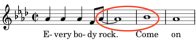
A century later we find several more examples, all more simply constructed. The example we cite is from the self-referential rock tune, Rock and Roll Is Here to Stay, written by David White in 1957. The formation used here is more common of the kind seen in the other examples of the 20th century–an eighth note tied to a whole note and followed by another whole note. The pitch differential is a major second (+2 MIDI). Calculation: 16 / (2+16) = 0.889.
Intervals plus or minus an octave for duration ratio 0.889 found in the database (MIDI values):
-5, -4, -2, -1, unison, +1, +2, +3, +4, +5, +7, +8, and +9.
Example S3: 1.125 Duration Ratio, 69 tunes
How Formed: 9/8 ratio, such as a half note followed by a half note tied to a sixteenth note.
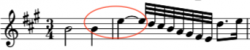
It is a little surprising that we don’t find the 1.125 duration ratio in a piece written in the 1600s because it appears fairly simple to form. Our first instance is in 1714 by Johann Mattheson in his Suite II in A major. Mattheson employed this duration ratio at the beginning of this section, as shown at the left. He jumps with a perfect fourth interval from a quarter note to another quarter note tied to a 32nd note. Calculation: (4 + 0.5) / 4 = 1.125.

Bach also used this duration, but in a different configuration, in 1736. Bach’s piece was his presto from Sonata No. 1 in B minor (BMV 1030), shown at the left. He forms the duration ratio quite simply with a whole note followed by a whole note tied to an eighth note. The interval is a major second. Calculation: (16 + 2) / 16 or 1.125.

Our example from the 19th century is from an impressionistic piece by Wilheim Popp called Birdsong, written in 1850 and shown at the left. The formation is similar to the Bach piece but each note is one quarter of the value in the Bach piece. The pitch differential is a minor third (+3 MIDI). Calculation: (4 + 0.5) / 4 or 1.125.
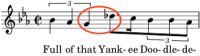
Our final instance is from a song written during the Great Depression, Brother Can You Spare a Dime by Jay Gorner in 1930. Here, the 1.125 duration ratio is formed with a pitch differential of a rarely used augmented fourth (+6 MIDI value), moving from a triplet quarter note to a dotted eighth note. Gorner uses only two notes to form this duration ratio and yet this simple pattern is unique in our Skiptune database. Calculation: 3 / 2.667 = 1.125.
Intervals plus or minus an octave for duration ratio 1.125 found in the database (MIDI values):
-7, -5, -4, -3, -2, -1, unison, +1, +2, +3, +4, +5, +6, +7, +8, +10, and +12.
Example S4: 0.778 Duration Ratio, 79 tunes
How Formed: 7/9 ratio, such as dotted eighth note followed by a sixteenth note tied to an eighth note triplet. It is unusual, but for this duration ratio most of instances we found in the database employ rests.

The first use we find of the 0.778 duration ratio is from the year 1705 in Bach’s famous Toccata and Fugue in D minor, BWV 565, in the adagio, prestissimo passage where the interval is a major second (-2 MIDI). Bach’s formation is clearly rare, employing an eighth note in a 7-note tuplet. If this were the only formation possible for a 0.778 duration ratio, it would not be surprising that its use was rare, but there are easier ways to form it. Calculation: 4 / (2 x 4/7 + 4) = 0.778.

Our 19th century example is from Franz Schubert’s Entre’acte No. 3 in Rosamunde, written in 1823, where he uses a major third interval (+3 MIDI). This is a much more straightforward way than Bach’s to construct the 0.778 duration ratio, using a dotted eighth note followed by a sixteenth note tied to an eighth note triplet. Schubert uses this formation but with a major third interval (+4 MIDI) just two measures later. Calculation: (2 x 2/3 + 1) / 3 = 0.778.

Our instance from the 20th century is from the opening measures of the bossa nova, Song of the Jet (Sambo do Aviao) from Copacabana Palace, written by Antonio Carlos Jobim in 1963. Jobim found a way to achieve the 0.778 duration ratio without the use of triplets or tuplets of any kind, though he does use two ties. The interval is a minor second (-1 MIDI). Calculation: (8 + 6) / (2 + 16) = 0.778.
Intervals plus or minus an octave for duration ratio 9.333 found in the database (MIDI values):
-12, -3, -2, -1, unison, +1, +3, +4, 5, and +7.
Example S5: 0.857 Duration Ratio, 70 tunes
How Formed: 6/7 ratio, such as a quarter note tied to a dotted eighth note followed by a dotted quarter note.

The 0.857 duration ratio was used sparingly until the 20th century. Ignoring an early use of it in combination with a rest in the 1700s, we find the first use of this duration ratio in Bunting’s first collection of Irish tunes, which included this 1809 variation of the Rose Dillon Largo, the original of which was composed by the blind harpist Turlough O’Carolan several decades earlier. Bunting achieves the duration ratio with just two notes, a double dotted eighth note followed by a dotted eighth note. Calculation: 3 / 3.5 or 0.857.

For our example in the romantic era we turn to Brahms, who used the 0.857 duration ratio in the presto II from his Hungarian Dance #12 in D minor, WoO 1, written in 1880. His configuration uses a dotted eighth note tied to a quarter note followed by a dotted quarter note with a perfect fifth interval going downward in pitch. Calculation: 6 / (3 + 7) or 0.857.

Our 20th century instance is from Never Will I Marry from Greenwillow, a tune written for a musical in 1959 by Frank Loesser. This instance is a good example of an occasion where a composer latches onto an unusual pattern and uses it multiple times in the same tune. Here we show its use twice in the opening bars, first with a major third interval down and then with a perfect fourth up. He uses it again later in the tune with no change in pitch. Calculation (same for both instances): 12 / (6 + 8) or 0.857.
Intervals plus or minus an octave for duration ratio 0.857 found in the database (MIDI values):
-12, -7, -5, -4, -3, -2, -1, unison, +1, +2, +4, +5, +7, and 11.
Example S6: 1.143 Duration Ratio, 41 tunes
How Formed: 8/7 ratio, such as an eighth note tied to a dotted half note followed by a whole note.

The first use of the 1.143 duration ratio in the database, shown at the left, was in the first few measures of the recapitulation portion of the third symphony by Beethoven, first movement. Beethoven wrote this symphony in 1804. The duration ratio was formed using an eighth note tied to a dotted half note followed by another dotted half note tied to a quarter note, all descending a major second in pitch. Calculation: (12 + 4) / (2 + 12), which is the same as 16 / 14, or 1.143.

The next use we found of the rarely used 1.143 duration ratio was just a few years later, but we’re citing it here because it occurred twice and right next to one another. At the left we see the final few measures of Bunting’s 1809 variation on a tune by Turlough O’Carolan called “Rose Dillon Largo”. He used the new formation once with a downward major second and once with an upward minor second interval. Calculation: 4 / 3.5 or 1.143.

We jump all the way to the rock era for our next instance in Twist and Shout, a 1960 dance tune. Although popularized by the Beatles, it had already been recorded and released twice before Lennon famously recorded it. The 1.143 duration ratio occurs toward the end of the song just as the singers transition from the lyrics to a building chord. The formation is quite different from that used in the 1809 Rose Dillon Largo in consisting of an eighth note tied to a dotted half note followed by a whole note. Calculation: 16 / (2 + 12) or 1.143.
Intervals plus or minus an octave for duration ratio 1.143 found in the database (MIDI values):
-7, -5, -4, -3, -2, -1, +1, +2, +3, +7, +9, and +12.
Example S7: 5.25 Duration Ratio, 50 tunes
How Formed: 21/4 ratio, such as an triplet quarter note followed by a dotted half note tied to an eighth note.

The first use of the 5.25 duration ratio in our database occurs in an allemande within Bach’s Partita #1 in B minor, BWV 1002, composed in 1720. Bach formed this duration ratio with a sixteenth note triplet followed by an eighth note tied to a dotted sixteenth note, all with a perfect fourth interval (midi value of 5). Calculation: (2 + 1.5) / 0.667 or 5.25.

We jump forward to around 1800 (we don’t know the exact year) to find use of the 5.25 duration ratio in the Magyar toborzo (Hungarian Recruiting Dance), written by Janos Bihari in the late classical era. Bihari formed this duration ratio with just two notes, an eighth note triplet followed by a double dotted quarter note with a perfect fourth interval. Calculation: 7 / 1.333 or 5.25.
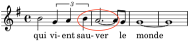
Our romantic period example comes from Gabriel Faure’s Les Rameaux (The Palms), written in 1872, shown at the left. This section appears toward end of the piece. Faure forms the 5.25 duration ratio with a quarter note triplet followed by a dotted half tied to an eighth note with a downward major second interval. Calculation: (12 + 2) / 2.667 or 5.25.
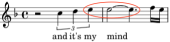
Our modern instance comes from the Lennon/McCartney tune, There’s a Place, written in 1964, but the formation of the 5.25 duration ratio is a various on that used in Les Rameaux: a triplet quarter note followed by a dotted half note tied to an eighth note. The Beatles used this formation with a unison interval four times in the piece. Calculation: (8 + 6) / 2.667 or 5.25.
Intervals plus or minus an octave for duration ratio 0.19 found in the database (MIDI values):
-7, -5, -3, -2, -1, unison, +1, +2, +3, +4, +5, +6, +7, and +12.
Example S8: 0.308 Duration Ratio, 70 tunes
How Formed: 4/13 ratio, such as an sixteenth note tied to a dotted half note and followed by a quarter note.

We find our first use of the 0.308 duration ratio in 1869 in Brahms’s Hungarian Dance No. 8 in Am, WoO 1, in a formation that only a “serious composer” could love. He used a minor second interval of an eighth note followed by a sixteenth note in a 13-note tuplet that would “normally” be occupied by eight sixteenth notes. Calculation: (8/13) / 2 or 0.308.
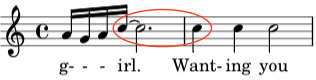
In more modern usage, of which there are only a couple dozen, we find a more ordinary formation, such as a sixteenth note tied to a dotted half note that is followed by a quarter note. Our instance is from For Your Precious Love, a 1958 pop and soul ballad written by Arthur Brooks, Richard Brooks, and Jerry Butler (who also sang it). They used the 0.308 formation in the transition to the bridge. The calculation is (4 / (1 + 12) or 0.308.
Intervals plus or minus an octave for duration ratio 0.308 found in the database (MIDI values):
-8, -5, -2, -1, unison, +1, +2, and +3.
Example S9: 0.107 Duration Ratio, 51 tunes
How Formed: 3/28 ratio, such as a whole note tied to a dotted half note and followed by a dotted eighth note.

We find the first use of the 0.107 duration ratio in a slow movement from Michel Pignolet de Monteclair’s Concert for Two Flutes, No. 4, in Am (Dialogue I). We estimate this piece’s date of composition with the midpoint of the composer’s adult life, 1712. Monteclair forms the duration ratio using a half note tied to a dotted sixteenth note followed by a 32nd note. Calculation: 1.5 / (8 + 6) or 0.107

Our romantic era instance is from the adagio in scene #27 from Tchaikovsky’s Sleeping Beauty ballet in 1889, shown above. In this highly unusual formation, Tchaikovsky uses a quarter note followed by a 32nd note in a 14-note tuplet. The interval is a downward major third. The computation is complicated by the 14-note tuplet that is fit into a space that would normally be occupied by 12 32nd notes. The 0.107 duration ratio was used several times before Tchaikovsky by other composers, but always employing rests. Calculation: (12/14 x 0.5) / 4 or 0.107.

We find an early 20th century use in 1906 by Debussy in his Le Petit Berger from Children’s Corner, L.113. Debussy formed the 0.170 duration ratio using an eighth note tied to a quarter note tied to a half note, all followed by a dotted sixteenth note. The interval is a major second. He did need to use multiple ties in order to achieve this duration ratio, but later in the century we see this duration ratio formed with a single tie. Calculation: (1.5 / (2 + 8 + 4) or 0.107.

We find the 0.107 duration ratio formed with a single tie at the end of the 1944 boogie-woogie version of Funiculi Funicula (originally written by Luigi Denza in the late 1800s). Here, the duration ratio is formed using a whole note tied to a dotted half note and followed by a dotted eighth note. There is no pitch change. Calculation: (3 / (16 + 12) or 0.107.
Intervals plus or minus an octave for duration ratio 0.308 found in the database (MIDI values): -10, 7, -4, -3, -2, unison, +1, +2, +3, +4, +5, +7, +9, and +12.
Example S10: 0.05 Duration Ratio, 56 tunes
How Formed: 1/20 ratio, such as a whole note tied to a quarter note and followed by a sixteenth note.
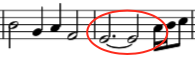
We find the first use of the 0.05 duration ratio in a 1669 piece called Northern Jigg, an English dance tune published in John Playford’s Apollo’s Banquet collection. It’s likely that the piece was written some years earlier, but the only date we have is the date of publication. The anonymous composer tied a dotted half note to a half note and followed them with a sixteenth note with a perfect fourth interval. This duration ratio is used twice in this tune but with different intervals. Calculation: 1 / (12 + 8) or 0.05.
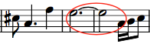
We have only to skip a few decades to find another instance of the 0.05 duration ratio. It occurs in a variation of Rockingham Castle, written anonymously and published in the 1703 edition of John Playford’s English Dancing Master. The duration ratio appears in the first strain of the piece. Its formulation is exactly the same as the 1669 use except that the interval is a perfect fifth (MIDI -7). Calculation: 1 / (12 + 8) or 0.05.

Bach picked up the 0.05 duration ratio in his 1720 allegro from Sonata No. 2 in Eb major, BWV 1031. Bach used three tied dotted quarter notes tied to an eighth note and followed by a downward fourth interval to a sixteenth note. Although there are three ties in this instance, that is not necessary to achieve the 0.05 duration ratio, as we shall see. Calculation: 1 / (6 + 6 + 6 + 2) or 0.05.
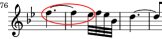
We find only a handful of instances from the romantic era, and our example is from Tchaikovsky’s Arabian Dance (Coffee) from his Nutcracker Ballet, written in 1891. Tchaikovsky achieves the 0.05 duration ratio with just a single tie by tying a dotted quarter note to a quarter note and following that by a 32nd note with a downward major second interval. Using this formation but with different intervals, Tchaikovsky includes the 0.05 duration ratio three times in Arabian Dance. Calculation: 0.5 / (6 + 4) or 0.05.
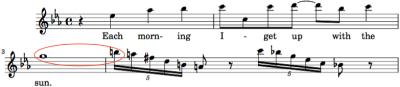
Our instance from the 20th century comes from the Gershwin standard, Fascinating Rhythm, written for the Broadway musical Lady Be Good in 1924, shown at the left. While we could have cited other examples from the 1900s, we cite the Gershwin instance to make a point about identifying melodies. There is some question as to whether we should include the 5-note tuplet as part of Gershwin’s melody because those notes do not have lyrics attached to them . However, the ear identifies the tuplet as part of the melody, and that is generally the rule of thumb that we follow. Gershwin former the 0.05 duration ratio with a whole note followed by a sixteenth note in a 5-note tuplet. Calculation: (0.8 / 16) or 0.05.
Intervals plus or minus an octave for duration ratio 0.05 found in the database (MIDI values):
-9, -7, -5, -3, -2, -1, unison, +2, +5, +7, +9, and +12.
Example S11: 0.118 Duration Ratio, 49 tunes
How Formed: 2/17 ratio, such as a sixteenth note tied to a whole note and followed by an eighth note.

We first find the 0.118 duration ratio early in the 20th century (1906) in a piece called Le Petit Burger from Debussy’s Children’s Corner, L. 113. Debussy employs an eighth note tied to a half note tied to an eighth note triplet, all followed by an eighth note triplet with a downward major second interval. Note that this formation requires a double tie. Calculation: 1.333 / (2 + 8 + 1.333) or 0.118.

It is possible to form the 0.118 duration ratio without a double tie, as shown in the instance at the left from a folk song in Carl Sandburg’s American Songbook called Chahcoal Man [sic], published in 1927. The anonymous composer achieved the 0.118 duration ratio by tying a sixteenth note to a whole note followed by an eighth note down a minor seventh interval. Calculation: 2 / (1 + 16) or 0.118.
Intervals plus or minus an octave for duration ratio 0.118 found in the database (MIDI values):
-10, -5, -3, -2, -1, unison, +1, +2, +4, +5, +7, +10, and +12.
Example S12: 4.333 Duration Ratio, 93 tunes
How Formed: 13/3 ratio, such as a dotted eighth note followed by a sixteenth note tied to a dotted half note.

The 4.333 duration ratio is a rare example of a duration ratio used early but seldom thereafter. The first instance we have is from Movetevi a pieta, #1 from Le Nuove Musiche by early baroque composer Giulio Caccini in 1601. Caccini uses a double tie to form the 4.333 duration ratio, but simpler formulations are possible. There is no pitch change. Calculation: (8 + 4 + 1) / 3 or 4.333.

Our 18th century instance of the 4.333 duration ratio occurs in On a Lady being Drown’d, a published piece in 1739 in a manuscript called Calliope or English Harmony, Vol. 2. The anonymous composer used a dotted eighth note followed by a dotted half note tied to a sixteenth note. The interval is a minor second (+1 MIDI). Calculation: (12 + 1) / 3 or 4.333.

Tchaikovsky used the 4.333 duration ratio in 1889 in the adapted from his Sleeping Beauty ballet, Scene No. 4 Final, Op. 66, and shown at the left. His formulation is not one we would ever expect to see again even though he uses no ties, as it incorporates a 64th note in a tuple of 13 notes. The interval is a major second. Calculation: 2 / (0.25 x 24/13) or 4.333.
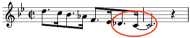
Our instance from the 20th century uses a much simpler formation with only one pair of tied notes. Night Train was written by Jimmy Forrest in 1951 in the swing and jazz genres, though this tune crossed over to pop and soon became a standard. Night Train’s 4.333 duration ratio is formed by a dotted eighth note followed by a sixteenth note tied to a dotted half note. The pitch change is a minor second downward. Calculation: (1 + 12) / 3 = 4.333,
Intervals plus or minus an octave for duration ratio 4.333 found in the database (MIDI values):
-7, -5, -4, -3, -2, -1, unison, +1, +2, +3, +4, +5, +7, and +12.
Example S13: 1.375 Duration Ratio, 48 tunes
How Formed: 11/8 ratio, such as a half note followed by another half note tied to a dotted eighth note.

The 1.375 duration ratio is another example of a pattern that was discovered early, but rarely used thereafter. Our first known use was in 1601 in Movetevi a pieta, #1 from Le Nuove Musiche, an early baroque piece by composer Giulio Caccini. His formation is a simple one, as befits a piece from this era, with an interval of a major second. Calculation: (8 + 3) / 8 or 1.375.

The passage at the left is from Mozart’s Marsch der Priester (March of the Priests) in the opera, The Magic Flute, written in 1791. This instance occurs late in the classical period and it is striking that such a simple-looking duration ratio should have escaped more use in the nearly two centuries between our first two instances. The pitch change is a major sixth (+8 MIDI). Calculation: (8 + 3) / 8 = 1.375.

Our instance from the 19th century is from a piece called Mediation from Thais, written in 1893 by Jules Massenet. The composer used the familiar formation of a half note followed by another half note tied to a dotted eighth note, along with an equally familiar major second interval. Calculation: (8 + 3) / 8 or 1.375.

The 1.375 duration ratio is rediscovered in the 20th century where it appears in a number of pop songs. The example we cite is from Inka, Dinka, Doo, a nonsense song sung by Jimmy Durante in 1933 that gained some notoriety and became his signature tune. The pitch difference is a minor second (-1) but the formation is exactly the same as that used by Caccini 330 years earlier. Although easily formed, the 1.375 duration ratio was only used in a half dozen pop songs in the first half of the 1900s, and with a small number of different intervals. This duration ratio is ripe for further exploration by composers.
Intervals plus or minus an octave for duration ratio 1.375 found in the database (MIDI values):
-11, -10, -9, -6, -4, -3, -2, -1, unison, +1, +2, +3, +4, +7, +8, and +12
Example S14: 1.6 Duration Ratio, 91 tunes
How Formed: 8/5 ratio, such as an eighth note tied to a half note and followed by a whole note.

Although the 1.6 duration ratio was used a few times in the 19th century involving rests, notably in the William Tell Overture, it is largely a modern invention, used for the first time without rests in Victor Herbert’s song “Moonbeams”. It appeared in the operetta “The Red Mill” in 1906 and again in a film version of the same in 1927. The ratio was formed by a sixteenth note tied to a quarter note followed by a dotted quarter note tied to an eighth note, descending a major second in pitch. Calculation: (6 + 2) / (1 + 4) which is the same as 8 / 5 or 1.6.

The 1.6 duration ratio was formed with different note durations in 1928 in George Gershwin’s What Causes That? from the 1926 musical Treasure Girl (and later re-used in Girl Crazy). Although this use requires a double tie, later formations by others employ a single tie. Calculation: (8 + 8) / (2 + 8) or 1.6.

In “Kisses Sweeter Than Wine,” a popular folk-type song written and recorded by The Weavers in 1950, composer Huddie Ledbetter used an eighth note tied to a half note and followed by a whole note (corresponding to the lyrics “again. Mmmm”), with an interval of a minor third (+3 in MIDI value), going from a G to a B♭. Calculation: 16 / (8 + 2) = 1.6.
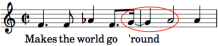
We next find this duration ratio used just a few years later in an early rock song called Chantilly Lace, sung originally by The Big Bopper in 1958. In yet another formation, the duration ratio of 1.6 is formed by a 16th note tied to a quarter note and followed by a half note. The interval is a major second. Calculation: 8 / (1 + 4) or 1.6.
The 1.6 duration ratio was used more often toward the middle part of the 20th century, and in fact was used five times with various pitch changes in 1964 (I Will Wait for You, Sweet Georgia Bright, Oh, Pretty Woman, Blue (Yarrow), and Can’t Buy Me Love). As this duration ratio is relatively unexplored, there is a lot of room for composers to use it with intervals that haven’t been tried before.
Intervals plus or minus an octave for duration ratio 1.6 found in the database (MIDI values):
-5, -4, -3, -2, -1, unison, +1, +2, +3, +5, +9, and +12.
Example S15: 5.667 Duration Ratio, 38 tunes
How Formed: 17/3 ratio, such as a dotted eighth note followed by a sixteenth note tied to a whole note.

The 5.667 duration ratio was used for the first time in the database in the vivace section of Quantz’s Flute Trio in D in 1726, shown above. This duration ratio is formed by a dotted quarter note followed by two tied dotted half notes that are further tied to a dotted quarter note and a plain quarter note. There are less tortured ways of achieving this duration ratio, as we’ll see in the 20th century. Calculation: (12 + 12 + 6 + 4) / 6 or 5.667.

The 5.667 duration ratio was used a few more times in the 1800s, such as this instance in 1889 in Tchaikovsky’s Sleeping Beauty ballet. As is often the case with Tchaikovsky, he tortures the duration ratio into existence by using a 64th note in a 17-note tuplet followed by a simple eighth note. If this were the only way to form the 5.667 duration ratio, we would not expect to ever see it again, but as we shall see there are simpler ways to make it. Calculation: 2 / (24/17) x .25 or 5.667.

It was another serious composer who used the 5.667 duration next. Debussy wrote Syrinx in 1913 and incorporated this ratio as shown at the left. Although this instance looks complex, Debussy’s formation is simple compared to Tchaikovsky’s. This duration ratio is formed even more simply later in the 20th century. Calculation: (1 + 4 + 0.667) / 1 = 5.667.
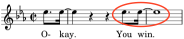
For our last cite of this duration ratio, we turn to a piece that demonstrates we don’t need a triplet to achieve a 5.667 duration ratio. At the very end of this 1955 pop and jazz song by Mayme Watts, “Alright, Okay, You Win,” we see a dotted eighth note followed by a sixteenth note tied to a whole note. Although we don’t usually cite examples from the end of tunes because endings can be arbitrary, this one does not feel contrived. Calculation: (1 + 16) / 3 = 5.667.
Intervals plus or minus an octave for duration ratio 5.667 found in the database (MIDI values):
-7, -5, -4, -2, -1, unison, +1, +2, +4, +5, and +7.
Example S16: 0.267 Duration Ratio, 78 tunes
How Formed: 4/15 ratio, such as a quarter note tied to a sixteenth note and followed by an eighth note triplet.

The 0.267 duration ratio is one where a lot of pitch differentials have been explored a few times each. Its first use without employing a rest was in one of the many versions of the United States National Anthem, this one a stylized variation written in March of 1885. There is no pitch change as a sixteenth note tied to a quarter note is followed by an eighth note triplet. Calculation: 1.333 / (1 + 4) or 0.267.

Our next example is from Debussy’s Syrinx in 1913, shown at the left. This formation is virtually identical to the previous instance in that it also involves a triplet, one tie, no pitch differential. Calculation: 1.333 / (1 + 4) or 0.267.

We want to show one more instance to illustrate a point. This one is from Somewhere, a crossover song from Leonard Bernstein’s West Side Story. Although Bernstein borrowed this theme from Tchaikovsky’s Swan Lake, the 0.267 duration ratio did not appear in Swan Lake because Tchaikovsky used a slightly different rhythmic scheme. So here we have an instance of a composer (Bernstein) borrowing from a master (Tchaikovsky) and changing it slightly to make it sound fresh. The interval is a perfect fifth downwards. Calculation: 8 / 30 or 0.267.
We observe that most of the other instances we found were also from musicals, such as Two Lost Souls from Damn Yankees, Sleigh Ride in July from Belle of the Yukon, Change Partners from Carefree, Everything’s Coming Up Roses from Gypsy, and Old Devil Moon from Finian’s Rainbow. We’ve noticed how often show tunes, which only comprise a small percentage of the tunes in our database, seem to be the first time many new patterns are used by composers, and eventually we intend to explore more rigorously the extent to which musical theater composers were the first to use patterns.
Intervals plus or minus an octave for duration ratio 0.267 found in the database (MIDI values):
-12, -8, -7, -6, -4, -3, -2, -1, unison, +1, +2, +3, +5, +7, +9, and +10.
Example S17: 0.045 Duration Ratio, 55 tunes
How Formed: 1/22 ratio, such as a whole note tied to a dotted quarter note followed by a sixteenth note.

The 0.045 duration ratio is rare because you need a very long note followed by a very short note (1/22 ratio) to achieve it. The first use of it we found was in a 1691 piece by Henry Purcell, the Overture to Gordion Knot Untied, #1, Z. 597. Shown at the left, the duration ratio is formed by a whole note tied to a dotted quarter note that is then followed by a sixteenth note. The interval is a minor second (MIDI of -1). Calculation: 1 / (16 + 6) or 0.045.

The instance we found in the 1700s has two occurrences of this duration ratio. The snippet at the left is from Advice to Britain, an anonymous Scotch ballad published in the Calliope or English Harmony, A Collection, Volume 2, in 1739. Both formulations of the 0.045 duration ratio is the same, but differ in the intervals used. They are used one after the other. Calculation: 0.5 / (3 + 8) or 0.045.

In the 1800s we find an instance of use in 1809 by Bunting in his variation of Pretty Girl Milking the Cow, one of the Irish folk songs he captured a decade before. Shown at the left, Bunting uses a quarter note tied to a dotted sixteenth note followed by a sixty-fourth note. (Interestingly, Bunting turns to this duration ratio again in 1840 when he publishes Irish Cry, Half Chorus of Sighs and Tears and uses the same formation, but doubles the values of each note in the formation.) Calculation: 0.25 / (4 + 1.5) or 0.045.

The 0.045 duration ratio shows up again in an early version of The House of the Rising Sun, but our instance at the left is from the song Speak Low from the musical One Touch of Venus, written in 1943. Shown here, the same formation as Bunting’s is used with a major second interval downwards, but where each duration value is four times that found in Bunting’s Pretty Girl Milking the Cow. Calculation: 1 / (16 + 6) or 0.045.
Intervals plus or minus an octave for duration ratio 0.045 found in the database (MIDI values):
-12, -10, -8, -4, -2, -1, unison, +1, and +2.
Example S18: 9.333 Duration Ratio, 33 tunes
How Formed: 28/3 ratio, such as an eighth note followed by a whole note tied to a quarter note triplet.
 The first citing we have in the database of the 9.333 duration ratio is from the lentement in Monteclair’s Les Ramages, Concert for Two Flutes #5, which was written in 1712. The formation is one we wouldn’t expect to find too often, as it consists of a 64th note in a sept-tuplet followed by a quarter note. The pitch differences is just a minor second interval downward in pitch. Calculation: 4 / (12 / 7 * 0.25 ) = 9.333. By way of explanation, “12 divided by 7” is the factor of each of the 64th notes needed to calculate the actual duration of the 64th notes in the sept-tuplet. The nominal value of each 64th note is 0.25 in the Skiptune system, and they have to be multiplied by that expansion factor to fit the amount of time in the measure.

We have another example a few decades later in the largo from a ballad opera dance called Les Satirs Punie, first published in 1741. The formation is different from about in that it uses a 32nd note followed by a quarter note tied to a sixteenth note triplet. The composer employs a minor second interval (-1 MIDI value). Calculation: (4 + 0.667) / 0.5 = 9.333.

Our 19th century example comes from a Verdi piece called Va’, Pensiero (Chorus of Hebrew Slaves) from Nabucco, written in 1842. This romantic era piece uses a perfect fourth (+5 MIDI) interval in the duration ratio as shown at the left. This romantic era formation uses notes exactly double of the one used a century earlier in the previous baroque era example.

Our 20th century example comes from K-K-K-Katy, a popular tin pan alley song during World War I, written in 1917 by Geoffrey O’Hara. Except for the key, this instance is identical to the previous example in its formation and perfect fourth interval. So far, the 9.333 duration ratio has been used more times in the 1800s than in the 1900s, but we expect that to change as we enter more 20th century melodies.
Intervals plus or minus an octave for duration ratio 9.333 found in the database (MIDI values): –5, -4, 3, -2, -1, unison, +1, +2, +3, +4, +5, +8, +9, and +12.
Example S19: 0.095 Duration Ratio, 35 tunes
How formed: 2/21 ratio, such as a dotted quarter note tied to a half note and followed by a triplet eighth note.

The earliest example in the database of the 0.95 duration ratio is from Beethoven’s Symphony #9, the fourth movement (the choral section) during the finale. It is shown here using a formation consisting of three dotted half notes all tied to each other and to a dotted quarter note, all followed by a single quarter note. The notes ascend a major second in pitch. Calculation: 4 / (12 + 12 + 12 + 6) which is the same as 4 / 42 or 0.095.

The 0.095 duration ratio is formed in a completely different and simpler way in La Paloma, a Spanish dance tune by Sebastian Yradier, dated to 1863. As shown, a dotted quarter note is tied to a half note and followed by an eighth note triplet. The pitch change is up a major third. Calculation: (2/3) x 2 / (6 + 8) or 0.095.

We jump about a century later to see a 20th century example, this one from the rock era called There Goes My Baby. Written by Benjamin Earl Nelson, Lover Patterson, and George Treadwell, the coda used the 0.095 duration ratio by tying a quarter note to a whole note that is then tied to a half note. All that is followed by a quarter note in a triplet with an interval of a major second downwards. Calculation: (2/3) x 4 / (4 + 16 + 8) or 0.095.
Intervals, plus or minus an octave, for duration ratio 0.095 found in the database (MIDI values):
-5, -4, -3, -2, unison, +1, +2, +3, +4, +7, and +8
Example S20: 1.8 Duration Ratio, 38- tunes
How Formed: 9/5 ratio, such as an eighth note triplet tied to an eighth note and followed by a dotted quarter note.

The 1.8 duration ratio was first used in 1871 in an early Christmas carol known as, “When Shepherds went their hasty way” (see the tune to the left). The use of this duration ratio occurs at the end of the introduction to the carol. This instance uses a dotted quarter note tied to a quarter note that is followed by an eighth note tied to a dotted half note that is tied to a quarter note. All the pitches are the same. Calculation: (2 + 12 + 4) / (6 + 4) = 1.8.

The 1.8 duration ratio was also used in 1925 in Who (Stole My Heart Away)? from the early American musical Sunny, music by Jerome Kern. Kern formed the duration ratio in cut time with a quarter note tied to a whole note and followed by two tied whole notes tied to a quarter note. Calculation: (16 + 16 +4) / (4 + 16) or 1.8. An instance of the 1.8 duration ratio being formed with only one tie can be found in Scotch and Soda, a bluesy song from 1937 (not shown), where the formation is a triplet eighth note tied to an eighth note followed by a dotted quarter note. Calculation: (16 + 16 + 4) / (4 + 16) or 1.8
Intervals plus or minus an octave for duration ratio 1.8 found in the database (MIDI values):
-9, -5, -4, -3, -2, -1, unison, +2, +5, +7, and +12.
Example S21: 3.25 Duration Ratio, 91tunes
How Formed: 13/4 ratio, such as a quarter note followed by a dotted half note tied to a sixteenth note.

While mostly used in modern times, the 3.25 duration ratio has its roots in a 1689 allemande that was simply called “Almand” (spelling was not standardized in the 17th century). The composer was Dr. John Blow and he formed the pattern with an eighth note followed by a dotted quarter note ties to a 32nd note. There is no interval change. Calculation: (6 + 0.5) / 2 or 3.25.

The 3.25 duration ratio was also used in the 18th century in a sarabande written by J.B. Loiellet in 1718. Loiellet used the same formation as did John Blow in the previous instance except for employing a minor third interval. Calculation: (6 + 0.5) / 2 or 3.25.

Aside from a few instances in the 1700s that involve a rest, the first use of the 3.25 duration ratio in our database was found in Chopin’s Valse de l’adieu, No. 1, Op. 69, written in 1835 and more commonly known as The Farewell Waltz. Chopin achieved the 3.25 duration ratio by using a complicated 13-note tuplet, but he did so using only two eighth notes. His interval change was an upward minor second. Calculation: 2 / (4/13 x 2) or 3.25.
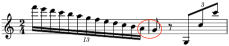
In another instance taken from the 19th century, Brahms uses the 3.25 duration ratio in exactly the same way as Chopin, though with a downward major second interval, in his Hungarian Dance No. 8 A minor, WoO 1, written in 1869. He formed the 3.25 duration ratio in a 13- note tuplet, as did Chopin, but his tuplet contained sixteenth notes, whereas Chopin’s contained eighth notes. The tuplet fits in 13 sixteenth notes where 8 would normally belong, so the duration value of each sixteenth note is 8/13. The value of the eighth note’s duration is 2, so the duration ratio is 2/(8/13), or 26/8, which computes to exactly 3.25. We cite these two examples from the 19th century because it’s remarkable that two composers coincidentally used such an uncommon formation. Calculation: 2 / (8/13 x 1) or 3.25.

The 3.25 duration ratio was used only another few dozen times in the 20th century, but the comprises the vast majority of all its instances. Our example at the left may look familiar to you. It’s the same example (Sh-Boom from 1954) we used in duration ration 0.231, but shifted by one note earlier in the piece. Here, a triplet eighth note is followed by another triplet eighth note tied to a dotted eighth note, and the calculation works out to (1.333 + 3)/1.333 or 3.25. This observation of two consecutive unusual patterns raises the question of how common this practice is among composers, a question we will answer elsewhere on the website when we compare metrics between and among genres and composers.
Intervals plus or minus an octave for duration ratio 3.25 found in the database (MIDI values):
-5, -4, -3, -2, -1, unison, +1, +2, +4, +5, +6, +8, and +12.
Example S22: 0.364 Duration Ratio, 36 tunes
How formed: 4/11 ratio, such as a dotted eighth note tied to a half note and followed by a quarter note.

The first instance of the 0.364 duration ratio not involving rests occurs in 1887 in Pourquoi Me Reveiller (Why Do You Wake Me Now?), a Romantic era aria in Jules Massenet’s opera “Werther.” The composer, Jules Massenet, ties a dotted eighth note to a quarter note and follows them with another quarter note. The interval is a downward octave. Calculation: 4 / (3 + 8) or 0.364.

A more modern example occurs several times in a jazz piece called ‘Heaven’ written by Duke Ellington and published in 1968. The 0.364 duration ratio occurs twice in one line using different intervals. Ellington’s formation involves multiple ties, in both cases an eighth note tied to a half note tied to a dotted half note followed by two tied quarter notes. Calculation: (4 + 4) / (2 + 12 + 8) or 0.364.
Intervals, plus or minus an octave, for duration ratio 0.364 found in the database (MIDI values):
-12, -5, -2, -1, unison, +1, +2, +3, and +7.