Somewhat (Surprisingly) Rarely Used Patterns
This page documents two-note patterns that are surprisingly rare, but not too rare. Elsewhere we define such somewhat surprisingly rare patterns as those occurring between 55 and 150 tunes in the Skiptune database and meeting other criteria. For each pattern we show:
⇒ The duration ratio in integer form as a fraction
⇒ The number of tunes in which the duration ratio was found in the database, including those involving rests
⇒ The chronological first instance of a duration that we can find in our database, but avoid those involving rests unless they are interesting.
⇒ The fractional form of the duration ratio and a verbal description of the notes needed to form that duration ratio
⇒ Examples of tunes from each century in which we have an instance of this duration ratio’s use. Each instance ends with how the duration ratio is calculated with the notes shown.
⇒ A list of intervals, within an octave around unison, that have been used to date with this duration ratio
Example S1: 2.75 Duration Ratio, 118 tunes
How Formed: 11/4 ratio, such as a quarter note followed by half note tied to dotted eighth note or a half note followed by whole note tied to dotted quarter.

The first instance we found of a two-note pattern using the 2.75 duration ratio was in Desperato’s Banquet from W. Strode’s The Floating Island, a morality play from 1636. The formation is straightforward: a quarter note followed by a half note tied to a dotted eighth note. The composer used a minor second interval. Calculation: (8 + 3) / 4) or 2.75.

Another instance in the same century was in Henry Purcell’s, “Beati omnes qui timent Dominum” (Blessed Are All Who Fear the Lord), in 1680. In this hymn Purcell followed a half note by a whole note tied to a dotted quarter note, using a minor second interval (MIDI +1). Purcell used this configuration twice in this piece. Calculation: (16 + 6) / 8 or 2.75.

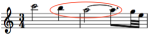
A few decades later in the 1700s, Benedetto Marcello used the 2.75 duration ratio in his Adagio I from the Recorder Sonata #4 in E minor, Op. 2, written in 1712 and shown at the left. Marcello used an eighth note followed by a minor sixth jump to a quarter note tied to a dotted sixteenth note. Marcello used this duration ratio with three different intervals in this piece. As we shall see, there are easier ways to form the 2.75 duration ratio. Calculation: (4 + 1.5) / 2 or 2.75.
Our instance from the 1800s is Irish Cry, Half Chorus of Sighs and Tears, a traditional Irish tune collected by Edward Bunting in the late 1700s but not published until 1840. Bunting was a trained musician and it is highly likely he was influence by the state of music as it was when he transcribed this tune from the oral tradition, so we use the published date as the date of record for this tune. Bunting uses a quarter note followed by a half note tied to a dotted eighth note. Calculation: (8 + 3) / 4 or 2.75.

Our final instance is from the 1900s, the tuneful Singin’ in the Rain from the eponymous musical. Written in 1929 by Nacio Herb Brown, the 2.75 duration ratio is used in a pattern with no pitch change: a quarter note followed by a half note tied to a dotted eighth note. This duration ratio appears elsewhere in the tune with major second, minor third, and perfect fourth intervals. Calculation: (8 + 3) / 4 or 2.75.
Intervals plus or minus an octave for duration ratio 2.75 found in the database (MIDI values):
-10, -8, -7, -5, -4, -3, -2, -1, unison, +1, +2, +3, +4, +5, +7, +8, +9, and +12.
Example S2: 0.625 Duration Ratio, 99 tunes
How Formed: 5/8, such as a half note followed by a quarter note tied to a sixteenth note.
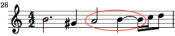
The first instance we find of the 0.625 duration ratio is in Giulio Caccini’s Movetevi a pieta, No. 1, from Le Nuove Musiche, written in 1601 early in the baroque period and shown at the left. It’s highly unusual to find a duration ratio used so early in Western music that was not used hundreds of times in the following centuries, and that makes this duration ratio all the more interesting. Calculation: (4 + 1) / 8 or 0.625.

We jump ahead a century to 1711 to find the 0.625 duration ratio used in Tomaso Albinoni’s Adagio III from Trattenimenti, Sonata #3 in Bb Major, Op. 6, shown at the left. While this formation violates our preference for only one tie, this duration ratio is commonly used by other composers which just one tie, justifying its inclusion here. Albinoni ties a dotted half note to a quarter note and followed with a half note tied to an eighth note to achieve this duration ratio. Calculation: (8 + 2) / (12 + 4) or 0.625.

Our instance from the 1800s comes from a little known piece called Meditation from Thais by Jules Massenet in 1893 late in the Romantic period. Massenet finds a third formation to yield the 0.625 duration ratio using a whole note followed by a half note tied to an eighth note. The interval is a major second (MIDI +2). Calculation: (8 + 2) / 16 or 0.625.

Our final instance is from early in the modern era, My Mammy written by Walter Donaldson for the 1921 musical, The Jazz Singer. While the lyrics to this tune would be considered politically incorrect these days, the tune is nonetheless wonderfully melodic. The formation for the 0.625 duration ratio is a familiar one. Calculation: (8 + 2) / 16 or 0.625.
Intervals plus or minus an octave for duration ratio 0.625 found in the database (MIDI values):
-12, -10, -8, -7, -5, -3, -2, -1, unison, +2, +3, +4, +5, +7, +8, +9, and 12.
Example S3: 0.429 Duration Ratio, 110 tunes
How Formed: 3/7 ratio, such as an eighth note tied to dotted half note followed by dotted quarter note, an eighth note triplet tied to a half note followed by a quarter note, or dotted eighth tied to quarter followed by a dotted eighth.
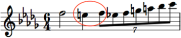
We find this duration ratio used as early as 1720 with rests, but the first one without rests was in 1831 by Chopin in his Nocturne No. 1, Op. 9, shown at the left. This example demonstrates that there are two-note patterns that are rarely employed by composers even today. Notice that the last seven 8th notes in this example form a tuplet because the seven notes are squeezed into the duration normally occupied by six 8th notes. If this duration ratio required a seven-note tuplet, it would not be surprising that its use was rare, but as we shall see there are easier ways to form it. Calculation: Each 8th note in the tuplet has the value 1.714 [calculated from (2 x 6)/7], and the quarter note that precedes the 8th-note tuplet has a duration value of 2; finally, 1.714/4 = 0.429.
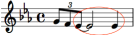
The 0.429 duration ratio was used sparingly in the 1800s, and only achieved some measure of use in the 20th century, especially in the rock era. Our next instance is one that involves triplets from The Great Pretender, a song written in 1955 by Buck Ram and made famous by Elvis Presley. Calculation: The value of an 8th note in a triplet is 1.33; the value of a half note is 8; and the value of a quarter note is 4 ; so the duration ratio is 4/(1.33 + 8) = 0.429.
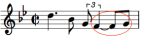
At the left is the 0.429 duration ratio in Where the Boys Are, a popular ballad from the early rock era and the title song of a film by the same name in 1960. Here, the 0.429 duration ratio is used with a major second pitch change (a MIDI value of +2). Observe that the quarter note is in a tuple that includes an eighth note, a use of this duration ratio we haven’t found anywhere else. Inside the tuplet the quarter note has a value of 2.67. Calculation: 2 / (2.67 + 2). (For the mathematically inclined, the calculation is not exact due to rounding the quarter note’s value in the tuplet, the value of which is technically 2 2/3 rather than 2.67.)

The next instance of the 0.429 ratio in the modern era is from Summer in the City, another popular rock song of the 1960s. The pertinent notes are the F dotted 8th note tied to the F quarter note followed by the A♭ dotted 8th note. The tied notes have a duration value of 7 (3 + 4), the A♭has a duration value of 3, and 3/7 = 0.429. The pitch difference is a minor third (MIDI value of +3). This duration ratio pattern occurs only once in the tune in the transition from the chorus (which ends with “summer in the city”) and the bridge beginning with the A♭.
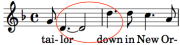
Our final instance of the 0.429 duration ratio is from one of the well-known variations of The House of the Rising Sun (1954). As shown on the left, the 0.429 duration ratio occurs from the end of the word “tailor” to the word “down”). This example contains notes whose durations are exactly twice the value of those in the previous example, Summer in the City. The pitch difference here is up an octave. This pattern is unusual because it is unique (only occurs one time in the database). For a song so well known, it’s somewhat surprising to find that the House of the Rising Sun contains a unique pattern that has been used by no other composer in any other song. Calculation: The dotted quarter note tied to the half note has a duration value of 14 and the dotted quarter note a value of 6, and 6/14 = 0.429.
Observe that there are at least five distinct formations of the 0.429 duration ratio that composers have invented. So not only is this duration ratio rarely used in melodies, composers find many different ways to express it.
Intervals plus or minus an octave for duration ratio 0.429 found in the database (MIDI values):
-9, -7, -6, -4, -3, -2, -1, unison, +1, +2, +3, +4, +5, +10, and +12.
Example S4: 0.214 Duration Ratio, 92 tunes
Value Ratio: 3/14 ratio, such as an eighth note tied to dotted half followed by dotted eighth note, or a dotted quarter note tied to a half note followed by a dotted eighth note, or an eighth note triplet tied to half note followed by an eighth note.

This is one of those duration ratios that are discovered early on by a composer, but largely ignored until the 20th century. At the left is the first use we find of the 0.214 duration ratio in the database, occurring in a section of melody called “Tryumph Victorious” in Dioclesian, Z. 627, in 1691. We don’t usually include examples with multiple ties, but as this is the first use of the duration ratio, we cite it here. (Purcell used the same formation with a different interval the same year in his Overture to the Gordion Knot Untied.) Purcell tied two dotted half notes to a quarter note, and followed them with a dotted quarter note. The interval is a major second (MIDI -2). Calculation: 6 / (12 + 12 + 4) or 0.214.

Although it was used a few times incorporating rests in the 1700s and 1800s, the 0.214 duration ratio was not used with any frequency until the 20th century. We cite a 1931 instance in a pop tune called I Don’t Know Why (I Just Do) that Frank Sinatra made famous, shown at the left. Composer Fred Ahlert used a triplet eighth note tied to a half note and followed by an eighth note in his formation. Calculation: 2 / (1.333 + 8) or 0.214.

The 0.214 duration ratio was used even more famously two years later in the 1933 standard, Stormy Weather, by Harold Arlen. Shown at the left, the 0.214 pattern is formed without a triplet, and with the pitch change up a perfect fifth (+7 MIDI value). Arlen also uses the duration ratio later in the song, but with a pitch change of a minor third (-3 MIDI value). Calculation: 3 / (6 + 8) or 0.214.
Intervals plus or minus an octave for duration ratio 0.214 found in the database (MIDI values):
-12, -9, -8, -7, -5, -4, -3, -2, -1, unison, +2, +3, +5, +7, +8, and +10.
Example S5: 1.2 Duration Ratio, 92 tunes
How Formed: 6/5 ratio, such as an eighth note tied to half note followed by dotted half, or a quarter note tied to whole note followed by dotted whole, or a sixteenth note tied to a quarter note followed by a dotted quarter note.

We admit to being surprised at the scarcity of the 1.2 duration ratio because it appears to be easily formed by many combinations of notes. The first use of this ordinary-looking duration ratio in our database that doesn’t incorporate rests was in 1760 by French composer Charles de Lusse, who did not use an easy pair of notes to employ this pattern. In this caprice, toward the end of the piece, he uses it twice, the first time with a perfect fourth interval and the second time with a minor second. In both cases, he formed the 1.2 duration ratio by following a sixteenth note in a tuple by a straight sixteenth note. He would be outdone by later composers in convoluted formations. Calculation: 1 / 0.833 or 1.2.
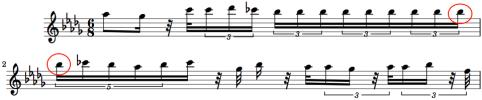
The next occurrence of the 1.2 duration ratio in the database occurs a century later in 1849 in a piece by Chopin, shown here. Chopin used none of the seemingly obvious ways to form this duration ratio, but instead formed it by following a triplet 16th note by a 5-tuplet 16th note. In the image above, this duration ratio occurs from the last note of the first measure to the first note of the second measure, both B♭ notes. When we first saw this example, we thought it was the most complicated way to form this duration ratio, but Tchaikovsky outdid Chopin as shown in the next instance. A sixteenth note in a 5-tuplet has a duration value of 0.8, while a sixteenth note in a triplet is worth 0.667. Calculation: 0.8 / 0.667 or 1.2.

In 1888 Tchaikovsky used the 1.2 duration ratio in his Andante II from the fourth movement of his 5th symphony in E minor (Op. 64). The 1.2 duration ratio occurs in the transition from the tied “B” 8th notes crossing over the time change and followed by a “B” quarter note. A triplet eighth note has a value of 1.67, and a simple eighth note has a value of 2. The following quarter note has a value of 4. The time change from 4/4 to 12/8 does not affect the calculation of the duration ratio. It’s interesting that such a simple but little exploited pattern occurs just this one time in this piece in such an unusual manner. Calculation: 4/(1.33+2) or 1.2.
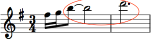
An example of a simpler way to form the 1.2 duration ratio is shown at the left. Just a year after Tchaikovsky, composer Benjamin Godard used this duration ratio in his Idylle from the Suite de trois morceaux (Suite of Three Pieces), Op. 116, second movement. The 1.2 duration ratio occurs almost at the very end of the idylle from the 8th note “B” tied to a half note and followed by a dotted half noted “D” and a pitch change of a minor third (+3 MIDI value). Calculation: 12 / (2 + 8) or 1.2.
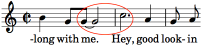
The 1.2 duration ratio was used only sporadically even in the 1900s. We provide just one example from “Hey, Good Lookin,” a song written and sung in 1951 by country-music personality Hank Williams. While there’s nothing unusual about the specific durations chosen, we cite this piece because it’s an example of how the Skiptune software can pick up patterns occurring during transitions. In this case the transition is from the verse to the chorus (lyrics: “me. Hey,”) with a pitch change of a perfect fourth (+5 MIDI). We do not always include transitions in the database, but when we do the patterns are discovered by the software. Calculation: 12 / (2 + 8) or 1.2.
Intervals plus or minus an octave for duration ratio 1.2 found in the database (MIDI values):
-5, -4, -3, -2, -1, unison, +1, +2, +3, +4, +5, +7, +8, and +12.
Example S6: 0.444 Duration Ratio, 167 tunes
How Formed: 4/9 ratio, such as a dotted quarter note followed by quarter note in a triplet or an eighth note tied to whole note followed by a half note.

The first use of the 0.444 duration ratio that we could find was in a 1649 toccata by Froberger, shown here. Froberger ties a dotted half note to a dotted quarter note and follows that pair with a dotted quarter note tied to an eighth note. The interval is a minor second. Calculation: (6 + 2) / (12 + 6) or 0.444.

Almost a century later we find the same duration ratio used in a more simple fashion: In Handel’s Adagio (1725) from the Recorder Sonata in G minor, HWV 360, op. 1, No. 2, and shown at the left. The 0.444 duration ratio occurs when the G thirty-second note tied to the G quarter note is followed by the F eighth note. The interval is a major second. Calculation: 2 / (4 + 0.5) = 0.444.

We jump to the romantic period during the 19th century for our next instance in Luigi Arditi’s “Il Bacio” (The Kiss), written in 1860. This is another example where the duration ratio of interest occurs during a transition, in this case while the key is changing from A♭major to F major. While the 0.444 duration ratio was scarcely used in the 1700s, there were nearly a dozen instances in the 1800s. Calculation: (12 + 4) / 36 = 0.444.

The 0.444 duration ratio was used much more in the 1900s, several dozen times, but still relatively sparingly. Interestingly, composers of several genres used this duration ratio in the 20th century, including latin dance music (Samba de Orfeu), Scottish folk songs (Inverness Gathering), film (I Wish I Didn’t Love You So from The Perils of Pauline), and show tunes (Indian Love Call from Rose-Marie). The instance shown here is from the rock ballad, Yesterday, by Paul McCartney. A unison pitch change with this duration ratio proved quite popular in the 1900s with around ten tunes using the combination, much more than any other pitch change. Calculation: 8 / (16 + 2) = 0.444.
Intervals plus or minus an octave for duration ratio 0.444 found in the database (MIDI values):
-12, -10, -9, -8, -7, -6, -5, -4, -3, -2, -1, unison, +1, +2, +3, +4, +5, +7, +8, +9, +10, +11, and +12.
Example S7: 4.667 Duration Ratio, 95 tunes
How Formed: 14/3 ratio, such as a dotted quarter note followed by whole note tied to a dotted half note.

The 4.667 duration ratio was used for the first time in the 1700s and was employed at least once in each following century, but primarily in the 1900s. The first instance in our database was in Recit de Nazard from Suite du deuxieme ton by Louis-Nicolas Clerambault, written in 1710. Shown at the left, the encircled notes have a major second interval (+2 MIDI value). Calculation: (4 + 3) / 1.5 or 4.667.

The example shown at the left a few decades later is from the largo section of Les Satirs Punie, a 1741 baroque piece by Johann Adolf Hasse. Unusual is the pitch change, a jump of a major sixth (+9 MIDI value). Here’s how the 14/3 ratio works out with this example: the quarter note has a value of 4, the triplet 16th note a value of 0.667, and the “B” 16th note a value of 1. Calculation: (4 + 0.667) / 1 = 4.667.

For our 19th century example, we turn to an arrangement of a duet in Mozart’s opera Don Giovanni by Saverio Mercadante, who arranged it in 1814 along with some variations. This example is from his statement of the main theme and occurs early in the piece in the fourth bar (the first four bars are shown here for context). The pitch difference is in the opposite direction from our first example, down a minor seventh (-10 MIDI value). We expect to find more examples of this duration ratio from the 18th and 19th centuries because we usually find duration ratios filling out first around unison before pitch changes reach the outer limits of an octave.

Our 20th century example is from the 1937 pop song Johnny One Note written by Richard Rodgers for the musical Babes in Arms. The pitch difference is a major second (+2 MIDI) and the 14/3 ratio is achieved by a quarter note (worth 6) followed by a whole note tied to a dotted half note (worth 28). While this 20th century example is from the show tune and jazz genres, the 4.667 duration ratio was used dozens of times in a variety of genres such as pop, film, American folk, and rock.
Intervals plus or minus an octave for duration ratio 4.667 found in the database (MIDI values):
-10, -9, -7, -4, -3, -2, -1, unison, +1, +2, +3, +4, +5, +7, +8, +9, +10, and +12.
Example S8: 0.15 Duration Ratio, 87 tunes
How Formed: 3/20 ratio, such as a whole note tied to a quarter note followed by a dotted eighth note.

The first use of the 0.15 duration ratio was in 1669 in John Playford’s country dance tune book and entitled La Princess Royal. Shown at the left, the instance occurs at the end of the section, and consists of a dotted half note tied to a half note and followed by a dotted eighth note. The interval is a minor second (+1 MIDI). Calculation: 3 / (12 + 8) or 0.15.

In the next century we find the 0.15 duration ratio used in 1734 by composer Johann Joachim Quantz in the very beginning of his Cantabile from Sonata No. 5 in Em, shown here. The pitch change is a minor second (-1 MIDI value). Calculation (a dotted sixteenth note is worth 1.5 in duration value): 1.5 / (8 + 2) = 0.15.

Our next example is from the 1800s, specifically in 1809 in Thou Flower of Virgins, a traditional piece first collected by Edward Bunting, the famous collector of traditional Irish folk music. Bunting collected ancient music in the late 1700s and published them in the first half of the 1800s, but was classically trained and wrote down the folk songs he heard with a then-modern ear. The cite at the left is an excellent example of how he modernized the pieces he heard. This selection is from an introduction to Thou Flower of Virgins, which is itself a simple folk tune, and is likely not at all ancient but rather influenced by the music developing in Bunting’s own time. The formation uses only two notes, but both are complicated. An unchanged 64th note has a duration of 0.25, but in the tuplet is reduced in value. The preceding triplet eighth note has a duration of 1.333. Calculation: (0.25 x 0.8) / 1.333 = 0.15.
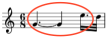
Our 20th century example is from America Lies Far Away, another Irish folk tune collected by another famous Irish folk tune collector, Captain Francis O’Neill, and published in 1903. It is possible that this tune was written by O’Neill rather than collected by him. The ratio is formed in a manner similar to that of the Quantz example, but uses a dotted quarter note tied to a quarter note instead of the half note tied to an eighth note. The pitch difference is an upward major sixth (+9 MIDI).
Intervals plus or minus an octave for duration ratio 0.15 found in the database (MIDI values):
-9, -7, -5, -4, -3, -2, -1, unison, +1, +2, +3, +4, +5, +7, +8, +9, +11, and +12.
Example S9: 10.5 Duration Ratio, 101 tunes
How Formed: 21/2 ratio, such as a triplet quarter note followed by a whole note tied to a dotted half note.

The 10.5 duration ratio was first used in 1720 by Bach in the allegro from his Sonata No. 2 in Eb major for flute & harpsichord (BWV 1031). This formation by Bach uses multiple ties, which we normally don’t include as an example, but we do so here because it is the first use of the 10.5 duration ratio in our database. There is no pitch change. Calculation: (6 + 6 + 6 + 3)/2 = 10.5

We jump to the romantic era for the next example, found in Theobold Boehm’s Souvenir des Alpes No. 5, Op. 31, written in 1852. The 10.5 duration ratio is formed with only one tie, but uses a sixteenth note in a 6-note tuplet (really just two triplets in a row). The pitch differential is a major second downwards. Souvenir des Alpes is an interesting example because Boehm used far more unique patterns here than composers generally use in a single piece. Calculation: (4 + 3) / 0.667 = 10.5.

Our 20th century example is found in the jazz and pop standard Misty, written in 1954 by Erroll Garner. The pitch differential is a major second upwards. Notice that this example’s notes are twice the duration value of the previous example (Souvenir des Alpes), and is a good illustration of how duration ratios don’t change when you multiply notes by the same factor. Calculation: (16 + 12) / 2.667 = 10.5.
Intervals plus or minus an octave for duration ratio 10.5 found in the database (MIDI values):
-9, -7, -5, -4, -3, -2, -1, unison, +1, +2, +3, +4, +5, +7, +9, and +12.
Example S10: 0.182 Duration Ratio, 122 tunes
How Formed: 2/11 ratio, such as a whole note tied to a dotted quarter note followed by a quarter note.

Within our database the 0.182 duration ratio can be found for the first time in the 1863 La Paloma, a very early tango by Sebastian Pradier. Shown at the left, the duration ratio is formed with a minor third interval using a dotted quarter note tied to an eight note triplet and followed by another eighth note triplet. Calculation: (1.333 / (6 + 1.333) or 0.182.

The 0.182 duration ratio was used a few more times in the 19th century, but our next example is from the early 20th century. The instance at the left is from Victor Hugo’s 1903 Babes in Toyland, taken from the pomposa in the country dance at the very beginning of the musical. The formation is unusual, an eighth note followed by a 32nd note tuplet, but he only used two notes and no ties to achieve it. The interval is a downwards minor third (-3 MIDI). Calculation: (8/11 x 0.5) / 2 = 0.182.

The 0.182 duration was used in its more usual formation, a whole note tied to a dotted quarter note followed by a quarter note, during many other 20th century tunes. We cite a section of the Beatles’ song, Help!, written in 1965, as our instance on the left to demonstrate. The interval is a perfect fourth upwards (+5 MIDI). Calculation: 4 / (6 + 16) = 0.182.
Intervals plus or minus an octave for duration ratio 0.182 found in the database (MIDI values):
-10, -8, -7, -5, -4, -3, -2, -1, unison, +1, +2, +3, +4, +5, +7, +8, +9, +10, and +12.
Example S11: 20.0 Duration Ratio, 108 tunes
How Formed: 20/1 ratio, such as a sixteenth note followed by a dotted half note tied to a half note.

The first instance of the 20.0 duration ratio is shown at the left, Courante No. 42 from Praetorius’s Terpsichore, published in 1612. It is highly unusual to find a rare pattern from the (late) renaissance period because patterns used early in music history are generally employed so many times over the centuries that they become common. The interval is a major second downwards (MIDI -2). Calculation: (24 + 16) / 2 = 20.

This duration ratio appears a few times in the 18th century and we take our instance roughly a century later during the baroque era in a tune called Whitney’s Farewell, an 1719 English country dance and folk song. The duration values are exactly half those of the previous example from the renaissance period. This time the interval is a major second upwards (+2 MIDI). Calculation: (12 + 8) / 1 or 20.

The 20.0 duration ratio was used a few times in baroque music, but we skip to the romantic era for our next two instances, both taken from Tchaikovsky’s 1891 Nutcracker Suite. The first is the dance known as Arabian Coffee, which uses a complicated 5-note tuplet with a major second interval downwards. Calculation: (6 + 2) / (0.5 * 4/5) = 20.

The second Nutcracker instance is from later in the same dance piece, also shown at the left. Here, Tchaikovsky achieves the same duration ratio without using a tuplet. The interval is a minor third (+3 MIDI). Tchaikovsky wasn’t the only composer to use this duration ratio in the 1800s, but there are only a few instances. Calculation: 10 / 0.5 = 20.

Our instance from the 20th century is from the Burt Bacharach tune Wives and Lovers. Bacharach uses a perfect fifth interval (+7 MIDI), but he achieves the 20 duration ratio with durations that are double those used in Tchaikovsky’s second example. Bacharach was known for his unusual intervals and indeed, this tune is the only one in the database with exactly this pattern. Calculation: (12 + 8) / 1 or 20.
Intervals plus or minus an octave for duration ratio 20.0 found in the database (MIDI values):
-12, -11, -9, -7, -5, -4, -3, -2, -1, unison, +1, +2, +3, +4, +5, +7, and +8.
Example S12: 0.231 Duration Ratio, 118 tunes
How Formed: 3/13 ratio, such as a dotted half note tied to a sixteenth note followed by a dotted eighth note.
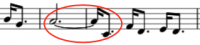
The first 0.231 duration ratio we encountered, not involving rests, was in On a Lady being Drown’d, a Scotch ballad written by Dr. Heighington and published in 1739. Shown here, the good doctor tied a dotted half note to a sixteenth note and followed them by a dotted eighth note with a major sixth interval (the C is sharped). This is a rare example of a piece where two highly unusual two-note patterns occur consecutively. The 4.333 duration ratio is also found in this tune but shifted one note to the left. Calculation: 3 / (12 + 1) or 0.231.

Jumping to the romantic era we find an instance in The Young Prince and the Young Princess from Rimski-Korsakov’s Scheherazade, written in 1888 and shown at the left. This rather unusual formation consists of only two notes, an eighth note followed by a 32nd note in a 26-note tuplet that has to squeeze into the space of 24 thirty-second notes. That gives it a duration value of (0.5 x 24/26) or 0.462 in our duration value system. Calculation: 0.462/2 or 0.231.

The 0.231 duration ratio was only used a few dozen more times and mostly in the 20th century. The sample at the left is from Sh-Boom (Life Could Be a Dream), a 1954 popular early rock song made popular by The Crew-Cuts. A far cry from Scheherazade, this formation uses the far more common pattern of a triplet eighth note tied to a dotted eighth note and followed by an eighth note. Calculation: 2/(1.333 + 23) or 0.231.
Intervals plus or minus an octave for duration ratio 20.0 found in the database (MIDI values):
-10, -9, -8, -5, -4, -3, -2, -1, unison, +1, +2, +4, +5, +7, +8, and +10.
Example S14: 3.333 Duration Ratio, 104 tunes
How Formed: 10/3 ratio, such as a dotted eighth note followed by a half note tied to an eighth note.

The 3.333 duration ratio is an old formation that nonetheless appears only a few dozen times over three centuries. The first use we found of it is in 1691 by Henry Purcell in “You say, ’tis love, Nymph”, Act V of King Arthur, Z.628. Purcell uses a dotted sixteenth note followed by a quarter note tied to a sixteenth note to achieve this duration ratio. He uses a minor second interval (+1 MIDI). Calculation: (4 + 1) / 1.5 or 3.333.

We found another use of this duration ratio in 1728: Vivaldi’s La Notte (Fantasmi presto), Op. 10 RV 439, Flute Concerto #2 in Gm, cited at the left. He achieves the 3.333 duration ratio using a dotted eighth note up to a perfect fifth to a half note tied to an eighth note. Calculation: (8 + 2) / 3 or 3.333.

Amazingly, we find only a few other instances in the 1700s, one by Bach in his Aria from the Goldberg Variations (BWV 988), and only a few instances in the 1800s, of which we are showing at the left an excerpt from Tchaikovsky’s Andante II in his 1888 Symphony No. 5, Op. 64. The interval is unison and he achieves the duration ratio differently from Vivaldi, employing an eighth note followed by a dotted quarter note tied to a triplet sixteenth note. Calculation: (6 + 0.667)/2 or 3.333.
 Use of the 3.333 duration ratio expanded in the post-Romantic period, although it did not explode. We are showing an instance from the 1915 early jazz standard, I Ain’t Got Nobody (And Nobody Cares for Me). Observe that this formation is different from the previous two instances in its use of a whole note. During the transition from the romantic era to the 20th century, the 3.333 duration ratio moves from the exclusive realm of “serious” music to popular music and will be used throughout the mid-1900s in popular music of many genres.
Intervals plus or minus an octave for duration ratio 3.333 found in the database (MIDI values):
-12, -9, -7, -5, -4, -3, -2, -1, unison, +1, +2, +3, +5, +6, +7, and +8.
Example S15: 3.75 Duration Ratio, 76 tunes
How Formed: 15/4 ratio, such as a quarter note followed by a dotted half note tied to a dotted eighth note.

The 3.75 duration ratio’s first use in our database was by Henry Purcell in his long work, Dioclesian (Z. 627), in a melody entitled “Tryumph Victorious” and published in 1691. Purcell followed a quarter note by a dotted half note tied to a dotted eighth note to achieve this duration ratio, all notes of the same pitch (unison interval). Calculation: (12 + 3) / 4 or 3.75.

A few decades later in the 1700s, the 3.75 duration ratio was used by Handel in his Adagio IV from the Flute Sonata in Bm, Op. 1, No. 9b, HWV 367b, shown at the left and written in 1712. Handel employs an unusual minor seventh interval (MIDI +10), going up in pitch, using a quarter note followed by a dotted half note tied to a dotted eighth note. The 3.75 duration ratio was only used a handful more times in the 1700s. Calculation: (12 + 3) / 4 or 3.75.
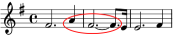
Our next instance is from the belly of the romantic era, Chopin’s Prelude in Em, Op. 28, No. 4, written in 1867. Chopin’s formulation is the same as Handel’s but with a minor third downward interval. The 3.75 duration ratio is one of those patterns that just looks as though it should have been commonly used by composers, and yet we find only a few dozen instances in history. Calculation: (12 + 3) / 4 or 3.75.
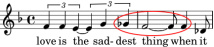
In the 1900s, our instance of the 3.75 duration ratio comes from Antonio Carlos Jobim’s bossa nova tune, Once I Loved, written in 1963. Jobim’s formulation is different from the previous instances in that he uses a triplet quarter note followed by a half note tied to a quarter note. The interval change is downward, but in general the intervals used with the 3.75 ratio display an unusual tendency of being heavily weighted toward those that move up in pitch rather than down (see the following paragraph). Calculation: (8 + 2) / 2.667 or 3.75.
Intervals plus or minus an octave for duration ratio 3.75 found in the database (MIDI values):
-10, -9, -7, -5, -4, -3, -2, -1, unison, +1, +2, +3, +4, +5, +6, +7, +8, +9, +10, +11, and +12.
Example S16: 1.167 Duration Ratio, 76 tunes
How Formed: 7/6 ratio, such as a dotted quarter note followed by a quarter note tied to a dotted eighth note.

Our first instance of the 1.167 duration ratio is from the 17th century, one of Johan Jakob Froberger’s toccatas written in 1649. Froberger uses a simple form, a dotted half note followed by another dotted half note tied to an eight note with a minor second interval. Calculation: (12 + 2) / 12 or 1.167.

We skip forward two centuries to 1840 to find our nexts instance in an Irish folk tune that Bunting collected called Ploughman’s Whistle contained the 1.167 duration ratio. Keep in mind that Bunting collected this tune in the 1790s; it therefore existed in and may be an instance of the 1.167 duration ratio in the 1700s, but because it wasn’t published by Bunting until 1840, we have no idea if he didn’t “modernize” the tune in putting it down on paper, influenced as he was by the emerging romantic era. To be conservative, we always treat such instances by using the year the tune was first published. Bunting (or the anonymous tune’s composer) achieved the 1.167 duration ratio with only two notes, a dotted eighth note followed by a double dotted eighth note. Calculation: (3.5/3) or 1.167.

Our 20th century instance is from All My Trials, a tune by Peter Yarrow, Paul Stooky, and Milt Okun that was inspired by a much older folk tune. The trio formed the 1.167 duration ratio using a half note tied to a whole note followed by a whole note tied to a dotted half note, all with no change in pitch. The calculation is ( 16 + 12 ) / ( 8 + 16 ) or 1.167.
Intervals plus or minus an octave for duration ratio 1.167 found in the database (MIDI values):
-9, -7, -5, -4, -3, -2, -1, unison, +1, +2, +3, +4, +5, +7, +9, and +12.