Quantifying a Bit of Music Creativity
Measuring human creativity may be impossible, but certainly some aspects of creativity can be quantified. This page documents the years when new two-note patterns are first used by composers. The use of new melodic patterns is certainly a major part of the creative process in music. Because the Skiptune database records an estimate of the year in which each tune is written, or at least first published, it is possible to chart the first time a pattern is used. Figure 1 shows when new patterns were first created and used for the last 500 years of music. This page was last updated in January 2026 when the database had 82,000 tunes.
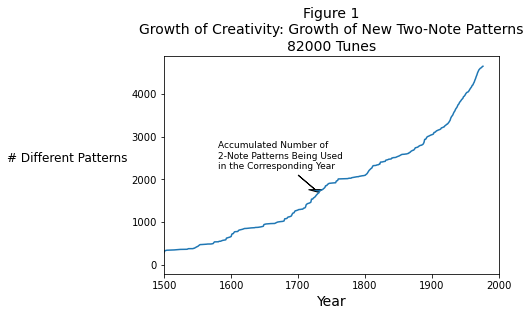
Figure 1 is consistent with what we might expect about the creative process of composers over time. The chart begins with the year 1500 because prior to that we did not have a close enough resemblance to today’s Western musical notation. The 1500s represent the second half of the Renaissance period where madrigals were being written and played, and musical notation was starting to take shape, but the figure shows that not many new patterns emerged during this century. The slope of the line between the years 1500 and 1600 is relatively flat compared to later centuries, and indeed the rate of two-note pattern discovery for this century was only 4.2 new patterns per year on average. That is, a little over four new two-note patterns were emerging every year, though it may not have seemed limiting to the musicians at the time as this was an age of discovery in other areas of music and the arts in general.
It is natural to ask why, if the Renaissance was such an age of discovery, were there so few new two-note patterns being uncovered. The Renaissance era, musically speaking, freed composers from the strictures of the medieval period with respect to virtually all aspects of music, including the range of pitches used, their durations (rhythms), harmony, the form or shape of the music composition itself, timber with new instruments, and even notation. Simply put, there were a lot of areas where composers could be creative and the combination of pitch and duration that make up a pattern was just one of them. Taken as a whole, the Renaissance period exploded musically speaking with many inventions, but when just one is isolated, such as two-note patterns, the creativity appears modest when compared with the development that occurs later.
The jump you may observe in Figure 1 around the mid-1500s does not represent a sudden burst of 2-note patterns. Our sources for renaissance music tend to be books published in a given year, but encompassing music written in previous decades. The historical record does not permit us more accuracy and the relative paucity of extant renaissance publications creates the jump. If we knew the years of authorship for the renaissance tunes, the average rate of new two-note patterns would be roughly the same, but the graph would likely show a smoother line.
The musical era known as the baroque period, roughly from 1600 to 1750, clearly broke from the renaissance period’s slow growth in new musical patterns for melodies. Scholars differ on the exact years demarcating the musical periods, but the ones shown here have a lot of adherents. Even though the eras overlap, and there is no bright line between musical periods, the delineation is useful for our purposes. Figure 2 is the same as the previous figure but with the end of the renaissance period and the entire baroque period delineated by the vertical lines.
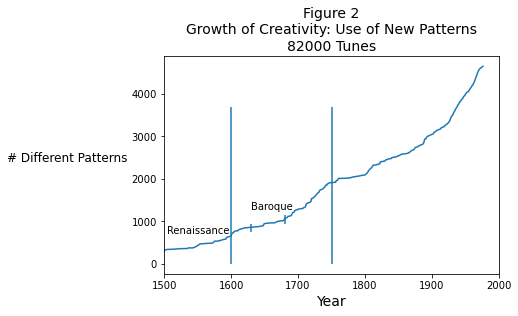
The baroque period is further broken down into early, middle, and late periods: 1600 to 1630, 1630 to 1680, and 1680 to 1750, respectively, demarcated in the figure by short vertical lines.
The dates of composition, or even publication, for many early tunes must be estimated. For instance, Jacques-Christophe Naudot was a French composer whose life spanned the first two parts of the baroque era. While his compositions have survived and stood the test of time, records for the years of composition were not kept. We know that the majority of his compositions were published between 1726 and 1740. So for the purpose of our work we peg his tunes at the midway point of that period, or 1733. This estimate may therefore tend to lump any new patterns Naudot may have created in 1733, rather than spreading them out in the years they were actually written. This has the potential to create the same “lumpiness” in the graph as we see in the renaissance period, but we have a much more detailed historical record in the baroque era to smooth the graph out as we enter more and more works where the year of composition is known. Note that in later years approaching our own time, the line gets quite smooth as we can identify the exact year of composition or publication.
Draw your attention in the above graph to the late period of the Baroque era, from 1680 to 1750, and note how steeply the curve rises. This represents an explosion of new melodic two-note patterns being uncovered by composers at that time. The first two periods of the Baroque era did show growth in new patterns, but the growth in the third period was unprecedented:
-
- 1600 – 1630 (early baroque): 5.1 new patterns per year
- 1630 – 1680 (middle baroque): 4.3 new patterns per year
- 1680 – 1750 (late baroque): 12.0 new patterns per year
- 1600 – 1750 (entire baroque era): 8.0 new patterns per year
The rate of growth in the late baroque period, over a dozen new patterns every year for 70 straight years, was almost three times the rate of growth of the renaissance period. One could argue that starting with a palette of only 1,076 two-note patterns to work with in 1680 (see the table at the bottom of this page), composers had an easy time finding new patterns, but that doesn’t diminish the explosion of creativity taking place in this period. Well-known works from the third Baroque period include Vivaldi’s Four Seasons, Handel’s Water Music and Messiah, Bach’s Brandenburg Concerti, and Pachelbel’s Canon in D
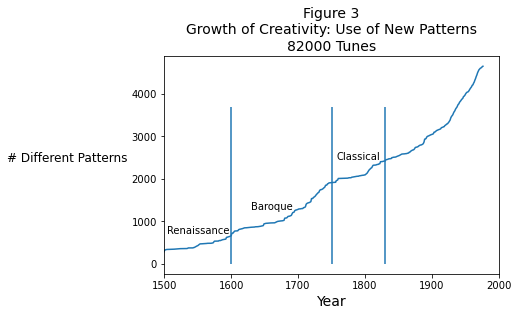
Figure 3 displays the same data but with the Classical era added, roughly 1750 to 1830. Note how the incredible rate of new melodic two-note patterns in the baroque era almost immediately slows down to a much lower pace at the beginning of the classical era. The rate of new patterns during the classical period is reduced to about 6.4 new two-note patterns per year, more than the renaissance era, but a little below the baroque era.
The classical era differed from the baroque era in many ways, but one of the biggest differences was the use of melody. During the classical era composers developed short but strong melodic lines with accompaniments that moved with the melody as harmonic lines. In the baroque era, the harmony was often supplied by the melodic line as well with large intervals (pitch jumps from note to note). The data suggest that classical composers took the many new two-note patterns discovered during the baroque era and spent their time exploring harmonies and compose many new melodies without continuing the explosive growth in new two-note patterns enjoyed during the baroque era.
Examples of tunes written during the classical era include many arias from Mozart’s Marriage of Figaro, his Eine Kleine Nachtmusik (A Little Night Music), Haydn’s 94th Symphony (which used the melody we know today as “Twinkle, Twinkle, Little Star”), many children’s songs still sung today such as “A-Hunting We Will Go,” and even popular church music such as Amazing Grace.
Around 1830 we begin the romantic era, shown on Figure 4, which differed from the classical era by being much more expansive. Composers loosened the strict forms that were self-imposed in the baroque and even classical eras, allowing the music to be played more freely and therefore with more emotion. One could say that the romantic composers threw the classical shackles off and explored the rich world of feelings that music can produce. Composers modulated to different keys to add the element of surprise to what listeners were accustomed to. Melody came into its own in the romantic era, becoming more lyrical. Rather than rigidly conforming to a strict duration of each note, composers experimented with shortening or lengthening the notes a little, producing many new two-note patterns. Importantly, folk music met “serious” music in the romantic era as many folk themes were reworked into concert pieces.
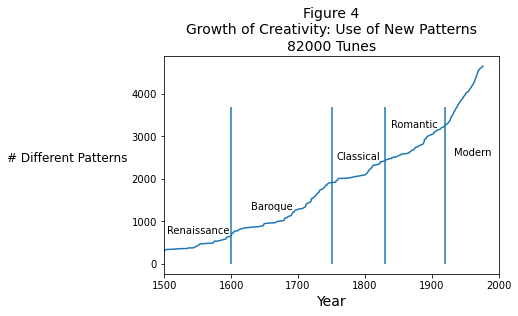
In incorporating such melodies, the increased rate of new patterns suggests that composers used a much larger palette in changes of pitch and rhythm compared to the classical era. The rate of new two-note patterns uncovered during the romantic era was 9.1 per year, more than even the baroque era (but less than the burst for late baroque). Visually, one can see that rate increase in Figure 4 by observing that the slope of the line during the romantic period is more consistently steeper than that of the baroque period.
So many beloved melodies came out of the romantic era that it’s hard to do them justice with just a few examples, but here are some well-known melodies: Almost any dance from the Nutcracker Ballet by Tchaikovsky, Beethoven’s Fifth Symphony, Strauss’s Blue Danube Waltz, Mendelssohn’s Wedding March, Bizet’s Carmen, Wagner’s Ride of the Valkyries, Grieg’s Peer Gynt Suite, Holst’s Planets, Rossini’s William Tell Overture, songs from operas such as La Traviata, and almost any Chopin waltz. Tuneful melodies also came out of the popular or folk tradition during this period, such as Yankee Doodle Dandy; You’re a Grand Old Flag; You’re in the Army Now; Baa Baa Black Sheep and many other children’s songs; Toyland from Babes in Toyland; Joplin’s The Entertainer; hymns such as Swing Low, Sweet Chariot and Rock of Ages; marches such as Sousa’s Stars and Stripes Forever; Irish folks songs such as Wearing of the Green and Danny Boy; holiday songs such as O Come, O Come Emmanuel and O Holy Night; and I Dream of Jeannie with the Light Brown Hair.
The final era is the 20th century. We may still be in that era, which blurs our ability to fix the year in which it begins, and we certainly cannot say when it ends. We are using 1920 as the beginning year, but years from now we may have better perspective to affix a starting point. As the 20th century began, many composers felt that the era they were in was getting too predictable. To many, for instance, the fact that all music resolves (that is, it reaches an end that music listeners feel as closure to the tension built up during the piece) had gotten boring. Musically speaking, some composers were tired of the fact that music began on the tonic and ended on the tonic. The 20th century is known, musically speaking, for breaking away from tonic composition and turning to atonal music, but that’s not all that was going on. Some composers, including those writing in the popular, folk, or many of the new emerging musical genres, broke out of the romantic era in other ways. Those breakouts include the use of new two-note patterns in new genres such as jazz.
As can be seen in Fig. 4, from 1920 to 1976 the use of new two-note patterns once again accelerated as we enter what is often called either the “20th century era” or the “modern era” (neither of those terms sound like they’ll stand the test of time). We see something quite remarkable when we measure the rate at which new two-note patterns were emerging during the 20th century: an average of 25 new patterns annually. This is the fastest rate of new pattern discovery in the history of western music by far. Even the late baroque period, which came the closest at roughly 12 new patterns per year, is half that of the modern era. For the 53 years from 1920 to 1976 there are no breaks from the relentless push of composers to create new two-note patterns in their melodies. We don’t know how long this growth rate will be maintained, but each year we add another year’s worth of tunes and we’ll report back here. We suspect that the growth continues well into the 1970s and then flattens out a bit, but that’s just conjecture at this point.
While our analysis of the genres in which this growth took place is ongoing, we can provide examples of tunes written in the 20th century era that contributed to this amazing growth:
- The Addams Family Theme
- House of the Rising Sun
- Alexander’s Ragtime Band
- Call Me Irresponsible
- Chantilly Lace
- Everything’s Coming Up Roses from Gypsy
- Getting to Know you from King and I
- Girl from Ipanema
- I Want a Girl (Just Like the Girl That Married Dear Old Dad)
- I’ve Got the World on a String
- Inka Dinka Doo
- Kisses Sweeter Than Wine
- Mood Indigo
- My Favorite Things from Sound of Music
- Oklahoma
- Rock-a-Bye Your Baby with a Dixie Melody
- Don’t Rain on My Parade from Funny Girl
- Seventy-Six Trombones from The Music Man
- Summertime from Porgy and Bess
- Sunrise, Sunset from Fiddler on the Roof
- Summer in the City
- We Can Work It Out by The Beatles
- Silver Bells
- Take the ‘A’ Train
- Somewhere from West Side Story
- On Broadway from All That Jazz
- New York, New York from On the Town
- Just Like a Woman (Dillon)
- Stormy Weather.
You may have noticed the absence of “serious music” from this list. That is due in part because “serious composers” were exploring non-melodic and atonal music that are outside the scope of this research. But it also may be due to the order in which we are entering music into the database and it’s too soon to make definitive statements about which genres contain the most innovation. However the more classically-trained composers fit in, such as Aaron Copland or Prokofiev, the list presented earlier in this paragraph suggests that Broadway musical composers, jazz composers, and rock composers invented many if not most of the new two-note patterns in the 20th century era.
For convenience, here is a table summarizing the rates of change of creativity for the musical eras:
Rates of New 2-Note Patterns Added in Each Musical Era
| Musical Era | Years | Beginning 2-Patt Count | Ending 2-Patt Count | Rate of New Patterns/Yr |
|---|---|---|---|---|
| Renaissance | 1500-1600 | 296 | 716 | 4.2 |
| Baroque | 1600-1750 | 716 | 1913 | 8.0 |
| — Early Baroque | 1600-1630 | 716 | 863 | 5.1 |
| — Mid-Baroque | 1630-1680 | 863 | 1076 | 4.3 |
| — Late Baroque | 1680-1750 | 1076 | 1913 | 12.0 |
| Classical | 1750-1830 | 1913 | 2420 | 6.4 |
| Romantic | 1830-1920 | 2450 | 3264 | 9.1 |
| 20th Century (Modern) | 1920-1969 | 3264 | 4651 | 24.8 |