Tchaikovsky
The largest change in pitch in the database, at 82,000 melodies, occurs in Ella Ketterer’s 1928 piano piece, Valse Petite, as it appears in Yours for a Song compiled by Janet E. Tobitt:

The MIDI drop in pitch is from the D two octaves above the treble staff down to the D below the bass clef staff. The MIDI values for those notes respectively are 98 and 38, so their difference is 60 MIDI values (half-steps). We know there larger drops in piano music, but this Ketterer piece is the larges drop we have so far in the database. If you play the audio recording of the piece, you may not hear either or both the highest and lowest notes, depending on the quality of your speaker hardware.
This piano piece is not well known, and one wonders what well-known pieces also contain a large drop in pitch from one note to the next.One such example from a popular piece is in Tchaikovsky’s Dance of the Sugar Plum Fairy in the andante section (Scene 14, variation II):

The interval has a MIDI value of 51 and is annotated in Figure 1. The interval jumps from a bass clef low “E” (MIDI value of 40) to a treble clef “G” (MIDI value of 91) above the staff, just over four octaves. There will certainly be larger intervals to be found as we enter less popular pieces in the future. Certain classical compositions, especially for piano, likely contain even larger pitch changes.
This finding is interesting, but not important because it is so arbitrary. We don’t differentiate properly between the sound of an instrument and the way its notes are written in a conductor’s score. Conductor scores have a convention known as octave transposition, where certain instruments are written in a different octave from that which they sound. This convention makes it easier for the musician to read the notes in the staff rather than below or above the staff.
Two examples at the opposite end of the spectrum are the double bass and the piccolo. The double bass player sees a middle “C” but sounds a “C” an octave below middle “C”. Likewise, piccolo players play an octave above the note they see on the score. If a melody moved from a double bass to a piccolo, the written notes entered into our database would miss those two octaves. We ignore this problem on this page for the sake (and fun) of just seeing where large intervals occur historically.
Paganini
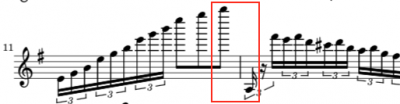
The next largest pitch change occurs in Paganini’s second violin concerto toward the beginning of the trio section. Shown at the left, this piece contains a drop of 4 octaves and a major second (50 MIDI values or half-steps). A violin has a rather wide range of over four octaves (not counting harmonics), so it is not surprising that a piece featuring a violin solo would have such a large interval.
Sousa
While there are larger intervals, perhaps the most familiar large interval occurs in John Philip Sousa’s “Washington Post March” toward the end of the piece. Sousa liked to contrast the sounds of high-pitched instruments such as the piccolo with low-pitched instruments like the sousaphone. (The sousaphone, or wrap-around tuba, bears his name in his honor.) Figure 2 shows the last few bars of the Washington Post March:

(Music engraving by Lilypond)
The large change in pitch occurs in the second last measure when a high “C” quarter note above the staff is followed by a low “G” 8th note below the staff. This is a change in MIDI value of 41, or three octaves and a fourth.
The Sousa example shows why it’s pretty tough to determine the largest interval in written music. If the higher note is played by a piccolo, which sounds an octave above its written score, the drop to the sousaphone, which sounds as it is scored, the actual interval is 53 (because 41 plus 12 is 53). This interval would therefore sound like more of an interval drop than the Tchaikovsky Sugar Plum Fairy above as played by a piano.